The US Presidency: executive orders push legal bounds of authority

Arriving in Washington, DC, new US President Donald Trump immediately began pushing the legal boundaries of presidential authority.
At his inauguration inside the US Capitol on 20 January, the President declared he would usher in a new ‘Golden Age’ for America. He promptly staged an executive signing ceremony before thousands of his supporters who’d gathered in a sports arena, delivering on a campaign promise of ‘shock and awe’.
Trump has issued more than 65 executive orders and memoranda in his first two weeks in office. This wave of activity marked a return to his combative, chaotic governance style.
Critics argue Trump is advancing an authoritarian style with his unilateral decisions. Attempts at severe spending and personnel cuts have sown confusion and alarm inside federal agencies. The White House has said, meanwhile, that there’s a need to ‘streamline our gargantuan government to better serve the needs of the American people.’
However, several orders have almost immediately led to lawsuits, presaging a Supreme Court showdown over the limits of presidential authority. ‘Presidents are entitled to impose their priorities,’ says Michael L Novicoff, a Member of the IBA Litigation Committee Advisory Board. He advises separating politics from the law in assessing events in Washington.
‘Giving instructions and setting priorities for the executive branch is what a president is empowered to do and indeed is one of the things he’s elected to do,’ says Novicoff, who’s a partner at law firm Pryor Cashman in Los Angeles. ‘Executive orders, however, cannot be used to direct executive branch employees to simply defy existing law.’
Executive orders cannot be used to direct executive branch employees to simply defy existing law
Michael L Novicoff
Member, IBA Litigation Committee Advisory Board
One of the incoming President’s early executive actions was an attempt to revoke birthright citizenship for children born in the US. The 14th Amendment to the US Constitution enshrines citizenship to ‘all persons born or naturalised in the United States, and subject to the jurisdiction thereof.’ The President ‘simply telling the executive branch not to recognisre citizenship that is granted by the Constitution, or to apply an interpretation of the Constitution that the Supreme Court has rejected, would not appear to be an appropriate use of an executive order,’ Novicoff says.
The White House argues that ‘the Fourteenth Amendment has always excluded from birthright citizenship persons who were born in the United States but not “subject to the jurisdiction thereof.”’
Twenty-two states and the cities of Washington, DC, and San Francisco as well as immigrant rights groups immediately filed lawsuits to block Trump’s order. A federal judge temporarily blocked the order on 23 January.
Much of Trump’s opening legal salvo is aimed directly at the US government’s role in the world. Trump issued an ‘America First’ foreign policy declaration and withdrew from the Paris Climate Agreement and the World Health Organisation. He paused almost all US foreign aid for 90 days, affecting about $68bn in programmes across 180 countries.
‘In the short term, we’re going to see a lot of pain,’ says Mary Ellen O’Connell, a professor of law at Notre Dame Law School in Indiana. ‘There is so much confusion. The sudden cut of foreign aid is going to hurt a number of very important programmes. It’s really very disruptive.’
Foreign aid is to be re-evaluated for alignment to Trump’s agenda, said Secretary of State Marco Rubio, who questioned whether the spending of money in this way made America safer, stronger or more prosperous.
How this matches the legislative intent of Congress is unclear. The funding has already been authorised under the Foreign Assistance Act 1961, which emphasises global interdependence and humanitarian ideals.
One of Trump’s first orders related to ‘America First’ trade policy, setting the stage for future tariff increases. ‘For President Trump, tariffs are about negotiating leverage on non-trade matters like immigration or fentanyl or something that relates to our national security,’ says Raj Bhala, Special Projects Officer of the IBA International Trade and Customs Law Committee. Judging by the past, the president’s rhetoric will include attempts to intimidate trade partners, says Bhala, who’s the Brenneisen Distinguished Professor in the University of Kansas Law School.
Eight of Trump’s executive orders signed on his first day together launched a sweeping plan to dramatically curtail immigration, deport millions and deploy the US military to secure the southwest border. ‘America’s sovereignty is under attack,’ Trump said, declaring a national emergency, which allows him to call up the military and order construction projects. ‘Our southern border is overrun by cartels, criminal gangs, known terrorists, human traffickers, smugglers, unvetted military-age males from foreign adversaries, and illicit narcotics that harm Americans.’
He directed the Immigration and Customs Enforcement (ICE) agency to begin making arrests of undocumented persons, reportedly demanding officers meet a quota of 1,200 to 1,500 arrests a day. Trump also ordered a new detention camp to be constructed in Guantanamo Bay.
The president gave his inaugural address surrounded by the heads of the richest, most powerful tech platforms in the world, including Elon Musk. Meta’s CEO Mark Zuckerberg, Amazon’s founder Jeff Bezos and Google CEO Sundar Pichai occupied coveted seats behind Trump inside the Capitol rotunda. Shou Zi Chew and Tim Cook, CEOs of TikTok and Apple respectively, were also there. Amazon, Apple, Google and Meta each reportedly gave $1m to Trump’s inaugural fund.
Musk, who pumped more than $200m into Trump’s election campaign, has been appointed to lead a new ‘Department of Government Efficiency’ (DOGE).
Indicative of the early chaos, an order by Trump’s Office of Management and Budget that froze all federal grants and loans was quickly rescinded after widespread confusion and a lawsuit.
Kim Lane Scheppele, a professor of sociology and international affairs at Princeton University, says Trump’s ‘giant flurry of legal actions’ amount to an assault ‘on democratic and constitutional institutions’. Scheppele, who has studied autocracies in Russia and Hungary, says they appear ‘to be reshaping the administrative state […] contravening or subverting the apparent mandate that agencies have from their authorising statutes.’
Maksym Yemelyanov/AdobeStock.com
Q&A: IBA President 2025 – Jaime Carey
Jaime Carey, Senior Partner of Carey in Santiago, Chile, is the IBA President for 2025. He is the first Chilean to occupy the position and has been an IBA member for more than 40 years.
Why did you choose to become a lawyer?
Both of my grandfathers were lawyers, my father was a lawyer and my three brothers were lawyers – one could say it runs in the blood. I have always liked both the profession and the business side. I started studying a combination of law and business in Spain and concluded my studies in Chile in just law.
I have always taken a business-focused approach to law and I have taken advantage of this in my role as senior partner for more than 20 years, which I have really enjoyed, together with significant client work.
What do you want to achieve as IBA President?
I believe we need to increase our presence in Asia and Africa. These are huge, highly populated regions that are underrepresented within the IBA, and I believe we have a debt with them.
With respect to Africa, we need to have more regional conferences there and a more consistent relationship with bars and law societies in order to contribute to upholding the rule of law and the independence of the profession. There are many situations in the region where the IBA can help tremendously, either through the IBA itself and its Divisions or through the IBA’s Human Rights Institute.
With respect to Asia, we also need to reach out more. In Asia, there is a larger language barrier. This means that we lose some opportunities to have excellent local speakers because they either do not speak English or do not speak well enough to present at a conference. Today with artificial intelligence (AI), there are simultaneous translation systems that are easy to implement and that are not expensive. This could mean a great leap forward.
The IBA Latin American Regional Forum is a great example of how things can be done well – it has grown tremendously and is still growing.
I also want to reach out to IBA Group Member firms to strengthen the relationships and the mutual benefits therein.
What are you most looking forward to during your presidency?
I am very much looking forward to visiting Asia and Africa to extend our reach in those regions. I am also looking forward to strengthening the bottom-up culture to have the various IBA committees be the drivers of projects, ideas and the organisation of showcase sessions at the Annual Conference, and to develop more and stronger specialist conferences worldwide.
What do you think will be the greatest challenge of your presidency?
One of the biggest challenges I foresee is the revamping of the IBA Annual Conference. The world is changing, and we need to adapt. There are many events that are organised around the Annual Conference that need to be coordinated so as not to compete and to be able to build on each other for the benefit of the IBA, its members and such organisations.
What do you consider to be the biggest law-related and societal issues currently?
My main concern is upholding the rule of law and the independence of lawyers, especially in connection with professional secrecy. With so much information contained today on smartphones, it is becoming very difficult to deal with this issue if a phone is seized or confiscated by a prosecutor, since there can be information on the phone pertaining to many other clients, or personal data of the owner, totally unrelated to any matter under investigation.
I am also very concerned about the malicious use of AI for purposes of spreading fake news and the increasing number of cyberattacks.
Most importantly, I believe that in many countries, we have inefficient legal systems and difficulties with access to justice due to very costly and extremely long procedures.
Finally, we need to make sure that jurisdictions have legal certainty and that laws are not inconsistently applied due to changing administrative procedures or given ideological reasons.
If you could go back in time, what would you change?
I would join the IBA and start going to the conferences earlier than I did.
What advice would you give to lawyers?
I have always been an optimist, and I have always believed in people. To me, personal relationships in business are crucial and one should always remember that clients are human beings that require empathy, and not undetermined entities without a soul.
Read the press release announcing Jaime Carey’s presidency here.
IBA Professional Wellbeing Commission publishes results of 2024 Workplace Wellbeing Survey
The IBA Professional Wellbeing Commission has published the findings of a new survey on workplace wellbeing in the legal profession. The Commission was formed in 2021, following the publication of the IBA’s landmark study Mental Wellbeing in the Legal Profession: A Global Study. The Commission circulated the survey via several IBA committees to inform its continued work and was completed by 236 participants in July 2024.
The survey considered how law firms are engaging with workplace wellbeing issues, the impact of the Covid-19 pandemic on attitudes towards mental health and wellbeing, the positive workplace practices currently being promoted and the intent to support workplace wellbeing versus how this translates in practice.
The survey found there remain low levels of awareness within the legal sector regarding the value of law firms engaging with workplace wellbeing issues, with a lack of appropriate engagement in promotion and support for mental health and wellbeing. Fifty-eight per cent of respondents disagreed that law firms in their jurisdictions are ‘generally effective at prevented work-related mental health and wellbeing issues from arising’.
Forty-one per cent of participants said that attitudes to mental health and wellbeing issues in the legal sector have changed as a result of the Covid-19 pandemic. They indicated that the pandemic encouraged great awareness of these issues, although several respondents suggested that this awareness had not yet been translated into effective action. Hybrid working was mentioned in both positive and negative terms, on the one hand being considered more accepted than before the pandemic, and on the other creating an expectation for lawyers to be reachable 24/7. Changes in attitude to wellbeing therefore appear to have had both positive and negative impacts.
Sixty-three per cent of participants indicated that the promotion of employee’s wellbeing is an integral part of their organisation’s overall strategy. However, only 39 per cent said that their organisation regularly evaluated the effectiveness of its wellbeing practices, hence there is a significant mismatch between the intention to support workplace wellbeing and firms taking practical steps to back this up.
Read the full analysis and discussion here.
New report: recommendations on attracting Gen Z to the legal profession
The IBA Future of Legal Services Commission has recently published a report addressing the question of whether Generation Z (Gen Z) is losing interest in careers in law. By 2030, Gen Z will account for more than 30 per cent of the global working profession, hence it is important to consider the attractiveness of the legal profession to this generation.
Overall, the report finds that there is no statistical evidence of any fall-off in the relative attraction of law as a subject of study. The expansion of international education has been a significant contributor to this, with an estimated four to five per cent of international students opting to study law.
Gen Z value diversity, progression, financial security and social values such as sustainability in deciding who they work for. Surveys of the characteristics that Gen Z might look for in an ideal career suggest that the legal sector should be a good match. However, those Gen Zers already in the workforce have expressed general dissatisfaction (not specifically about legal training) about how they have been prepared for work by any education and training they have undertaken.
The report finds that employers should be prepared to radically alter traditional work cultures, improve supervision and mentoring capacity, mainstream sustainability and target retention as Gen Z enter the workforce.
Read the full report here.
Edward Hunt Talmage III – In memoriam
The IBA was saddened to learn that the former IBA Section on Energy, Environment, Natural Resources and Infrastructure Law (SEERIL) Chair, Edward Hunt Talmage, died on 12 January after a short illness, at the age of 80.
A well respected and popular member, he had a long involvement with the IBA and SEERIL which included his tenure as Chair in 2009 and 2010. In addition to this, he was also an IBA Legal Practice Division (LPD) Council Member for some five years. Finally, he was a Councillor Emeritus for the LPD from 2013 onwards.
A noted energy lawyer, Hunt practised law for more than 50 years, only retiring in 2022. He lived and worked in various countries around the world over the course of his life, including the Ivory Coast, Lebanon, Thailand and the United States.
He is survived by his wife, four children and nine grandchildren.
The forthcoming editorial in SEERIL’s Journal of Energy and Natural Resources Law will honour Hunt and share tributes from IBA colleagues and friends.
Global Insight podcast – navigating AI regulation in the EU
Following a lengthy process, the European Union’s Artificial Intelligence Act came into force in 2024 and will regulate AI systems in the European Union based on which ‘risk category’ they fit into. Its provisions will mostly become applicable during the next two years.
This Act is far from the only piece of legislation or agreement covering AI in the EU, with others including the recently updated Product Liability Directive, a proposed AI Liability Directive and the Council of Europe Framework Convention on Artificial Intelligence, which opened for signature in September 2024. The latter aims to ensure that activities within the lifecycle of AI systems are fully consistent with human rights.
In this podcast, Global Insight considers the significance of the developments with:
- Marc Rotenberg, President of the Center for AI and Digital Policy and Chair of the IBA’s AI Task Force;
- Susie Alegre, human rights barrister and author on the impact of AI on human rights; and
- Ed Turtle, a senior lawyer on the Products Team at Cooley, focusing on tech and AI products; also an officer on the IBA Product Law and Advertising Committee.
Explore all Global Insight podcasts here.
IBA opens applications for general interest sessions at 2025 Annual Conference
The IBA has published the application process for those interested in organising and running a session or workshop at the IBA 2025 Annual Conference, to be held in Toronto, Ontario, Canada, in November.
Each year, in addition to the 200-plus sessions organised by the IBA’s core substantive Committees, the Conference features a programme of general interest sessions. These cover subjects such as international networking, maintaining and developing client relationships, how to give a winning presentation and practical tips for public speaking. In this way, Conference delegates are offered an opportunity for personal development as part of their attendance.
Those interested in facilitating such a session can put forward a proposal via the form on the IBA website. The deadline for submitting proposals is Friday 28 February. All proposals will be assessed by the IBA Annual Conference Session Review Committee, who will ensure the content isn’t duplicative of any sessions being run by IBA Committees. Applicants will be notified of the Review Committee’s decision by the end of March.
Sessions will be run in a 75-minute time slot between Monday 3 – Friday 7 November.
For full details, including a summary of the information proposals should contain, visit here.
IBA webinar programme provides learning on range of ESG issues

The IBA African Regional Forum is running specialised ESG (environmental, social and governance) training, consisting of monthly webinars and focused on legal practitioners across Africa.
The IBA ESG Accelerator Training Programme began in autumn 2024 and will continue into spring 2025. Featuring a diverse array of legal experts and case studies from across the African continent, the programme provides lawyers with a sound understanding of how a wide range of ESG issues have an impact on their daily legal practice.
While the programme is tailored to lawyers practising in Africa, given the critical challenge and opportunity that ESG presents, all legal practitioners globally will benefit from attending.
The programme is supported by the IBA Energy, Environment, Natural Resources and Infrastructure Law Section, the IBA Business Human Rights Committee and the IBA Legal Policy & Research Unit, as well as law firm Webber Wentzel.
Watch recorded sessions and register for future instalments here.
BRICS expansion into payment systems poses threat to dominance of US dollar
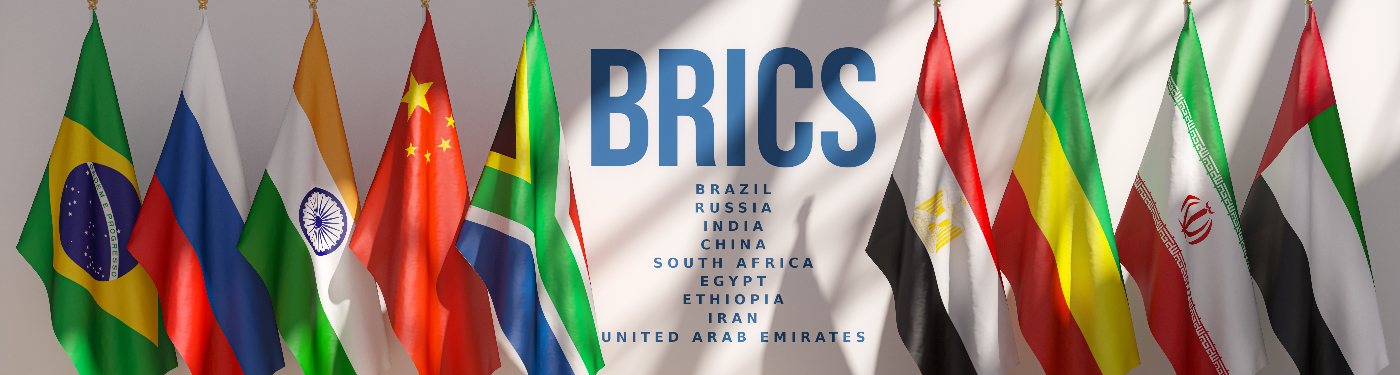
The recent expansion and shifting objectives of the BRICS bloc suggest an escalating rivalry between its members and Western liberal economies – and a potential threat to the status of the US dollar within international trade.
BRICS – originally comprising Brazil, Russia, India, China and South Africa, but expanded in 2024 to include Egypt, Ethiopia, Iran and the United Arab Emirates (UAE) – met for its 16th summit in Kazan, Russia, in October. The summit showed that Russian President Vladimir Putin is far from isolated, despite the West’s efforts in supporting Ukraine militarily and intensifying sanctions against Russia.
The summit also looked to advance the BRICS Pay initiative, a direct challenge to the SWIFT international payments network. SWIFT is the global standard for bank transactions, which are largely in US dollars.
BRICS – formed in response to the global muscle of the Group of Seven (G7) countries – now represents around 45 per cent of the world’s population and 35 per cent of global gross domestic product (GDP), based on purchasing power parity. The G7, meanwhile, only accounts for ten per cent of the global population and 30 per cent of GDP. This data suggests that the G7’s influence on global economic affairs could weaken.
The BRICS bloc previously sought reform of multilateral financial institutions, particularly the International Monetary Fund, but its purpose has shifted. ‘BRICS once represented a reformist group seeking to participate in existing institutions, rather than creating new institutions or international organisations,’ says Carol Monteiro de Carvalho, Member of the IBA International Trade and Customs Law Committee Advisory Board.
Now, with oil-producing states joining the bloc, BRICS has even more weight if it acts collectively and puts aside individual political and commercial interests – for example, the US remains China’s primary trading partner.
BRICS itself is seeing increasing trade volumes, though this can be ascribed to the commercial and political trading power of China. While China is a major trading partner for Brazil, India, Russia and South Africa, the economic connections aren’t necessarily as strong among the other founding members. ‘Trade flows between Brazil and South Africa, as well as between Brazil and Russia, remain relatively small and focused on specific sectors, such as fertilisers,’ explains Monteiro de Carvalho, who’s also a partner at Rio de Janeiro-based Monteiro & Weiss Trade.
BRICS Pay was a major focus at the Kazan conference. As proposed, the decentralised scheme would allow BRICS countries to trade with each other without converting to US dollars by utilising blockchain technology and tokens, effectively circumventing the SWIFT network.
The exclusion of several Russian banks from SWIFT following the country’s invasion of Ukraine has fuelled the Kremlin’s ambitions to create an alternative financial system. BRICS Pay is promoted as a means of reducing costs, enhancing efficiency and potentially shielding countries from sanctions imposed by the West.
BRICS Pay marks a significant step towards a multipolar global economy
Ramesh Vaidyanathan
Former Co-Chair, IBA Asia Pacific Regional Forum
Ramesh Vaidyanathan, former Co-Chair of the IBA Asia Pacific Regional Forum, believes that BRICS Pay could have a transformational impact on world trade. ‘It marks a significant step towards a multipolar global economy, reducing the dominance of the US dollar and creating a more balanced trade environment for developing nations,’ says Vaidyanathan, who’s Managing Partner at Mumbai-based firm BTG Advaya. ‘It could also spark increased competition between Western and Eastern economic models, with long-term geopolitical implications.’
Yet, in practice it may be tough for BRICS to de-dollarise and exchange dollar reserves for a currency that’s not as strong and stable. ‘In my mind, there are issues between those countries that make up the BRICS community,’ says Michael Diaz, Global Managing Partner of Diaz, Reus & Targ, who’s based in Miami. ‘I don’t believe that they will settle on a unified currency, because they all have national security concerns. They could move to digital bitcoin, but because of the individualised interests of those countries, I don’t see it as a risk to the US dollar.’
The extent to which BRICS members look to deepen intra-organisation relationships at the expense of those outside the bloc could result in a further retreat from the globalisation movement. ‘The very cohesion of BRICS ultimately favours a more fragmented international trade profile into competing blocs,’ says Monteiro de Carvalho.
Global banks, accountants and law firms have primarily emerged from Western liberal economies, particularly the US and UK, but now find themselves with limited access to the largest economies within BRICS – Brazil, China, India and Russia.
Given the polarisation and competition between the G7 and BRICS, this could encourage more protectionist tendencies, but globalisation won’t be dismantled. While China is a central member of the BRICS, its globalised stance services its commercial interests. ‘Within BRICS, China acts as a globalising agent, with its initiatives primarily aimed at opening markets for its products and companies. In the global context, this stance contrasts with countries that have adopted more protectionist measures,’ says Monteiro de Carvalho. ‘It is also important for companies to understand that the trade policies of each BRICS country will not necessarily be dictated by the bloc at this time.’
Brazil will assume the presidency of BRICS in 2025 and is expected to push for greater cooperation between its members. Whether this will mean greater polarisation between BRICS states and Western liberal economies is unclear, but it’ll certainly heighten tensions. Any state that chooses to align itself with Iran and Russia – and perhaps to a lesser degree, China – has a greater prospect of facing scrutiny and potentially penalties from the US and its allies.
Under the incoming Trump administration in the US, Diaz predicts an escalation of tariffs to protect the dollar, possibly alongside further sanctions. ‘We expect to see a spike in sanctions, compliance and white-collar criminal investigations directed at political leaders that the US perceives as bad actors,’ he says.
It all feeds into the narrative of the G7 versus BRICS, though given the well-established trading relationships between members of both organisations, the situation is complicated. Vaidyanathan believes that the apparent unity within BRICS – and the bloc’s recent expansion – shouldn’t be ignored. ‘The BRICS group is making a concerted effort to coordinate their policies, which may eventually translate into a reduction in the dominance of the US dollar as the currency of choice for global trade and foreign exchange reserves, the use of SWIFT as a global trade platform and that of Western economies in technological leadership,’ he says.
Maksym Yemelyanov/AdobeStock.com