How to score in football’s World Cup host countries
Alex Llevat
RocaJunyent, Barcelona
CONFERENCE REPORT
IBA Annual Conference Toronto 2025, Monday 3 November
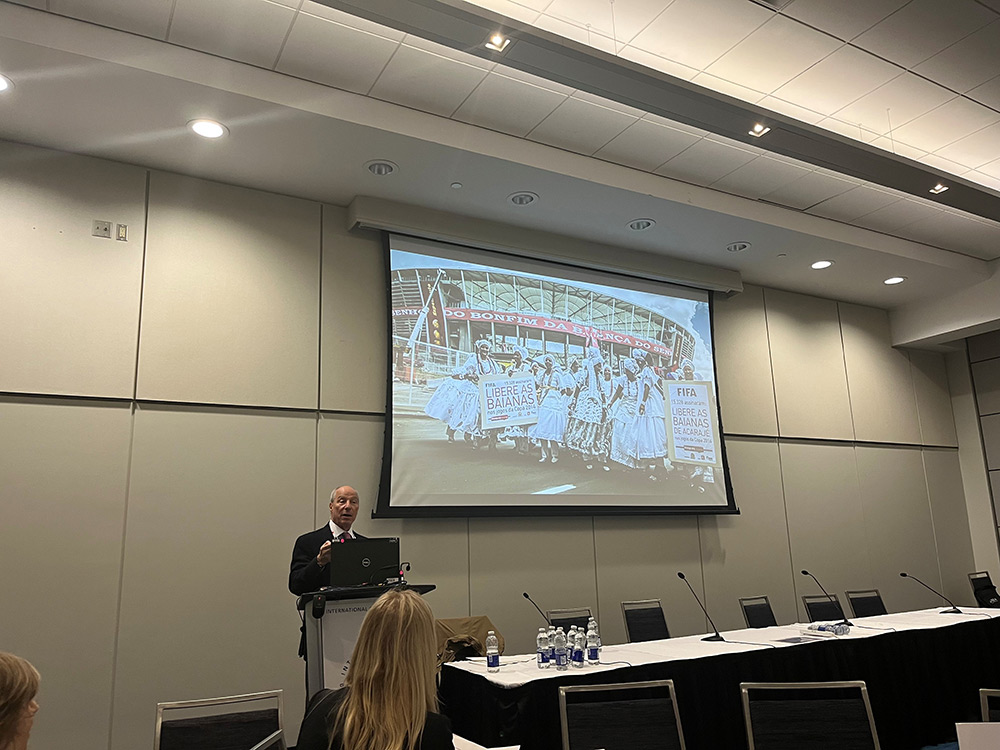
Francisco Müssnich, Vice-Chair of the IBA Securities and Capital Markets Committee, presenting at the 2025 IBA Annual Conference in Toronto, 3 November. Courtesy of Alex Llevat.
An engaging and dynamic panel took place at this year’s Annual Conference, titled ‘How to score in football’s World Cup host countries’. The session was organised jointly by all six IBA regional fora: African, Arab, Asia Pacific, European, Latin American and North American. This produced a rare and enriching collaboration among the Association’s global divisions.
The session unfolded in three parts. It began with a presentation by Francisco Müssnich, a Brazilian lawyer (BMA Advogados, Rio de Janeiro), followed by another address by French lawyer Jalal El Ahdab (Bird & Bird, Paris). The final portion consisted of two interactive workshops, in which approximately 40 attendees chose to join one of two groups: one led by Francisco, which focussed on contractual and intellectual property issues, and the other, led by Jalal, was dedicated to disputes and international arbitration.
From the outset, it was clear that Francisco’s presentation would captivate the audience – particularly those with a passion for the beautiful game. He began by identifying the four core dimensions of any World Cup: sport, infrastructure, media and marketing, and politics. With both precision and flair, he guided the audience through the intricate ecosystem surrounding a global sporting event of such magnitude: broadcasting rights, transport logistics, security measures, content production, ticketing systems, facilities and the myriad layers of organisation required.
He emphasised the vast contractual architecture underpinning a World Cup which spans agreements with government authorities, service providers, local organisers, stadium owners, sponsors and media entities. Each relationship demands meticulous drafting, negotiation and risk allocation, all aimed at producing a single, cohesive product: the competition itself – protected, of course, by extensive audiovisual rights.
Illustrating the exceptional legal landscape that often accompanies such events, Francisco recalled the 2014 Brazil World Cup, where specific legislative measures granted temporary privileges, such as visa exemptions for travellers whose sole purpose was to attend matches and special regulatory advantages for FIFA officials. His remarks, delivered with characteristic Brazilian enthusiasm and sprinkled with good-humoured references to the unmatched artistry of Brazilian football, left the audience both entertained and enlightened.
The baton then passed to Jalal, whose presentation shifted the focus from contractual creation to dispute resolution. He explored the realm of international sports arbitration, outlining three principal categories of disputes: contractual interpretation and enforcement, player transfers, and disciplinary or regulatory matters. He further noted the increasing prevalence of conflicts concerning electoral processes and governance mechanisms within sports institutions. Strikingly, he observed that the overwhelming majority of sports-related disputes are resolved through arbitration, with only a small fraction ever reaching the jurisdiction of ordinary courts.
In the final segment, participants divided into the two aforementioned working groups to widen the discussion: an exercise that fostered spirited debate and valuable exchange. The session concluded with a joint plenary interaction between the groups, weaving together insights from both contractual and dispute-resolution perspectives.
Ultimately, the panel proved to not only be highly informative and intellectually stimulating, but also remarkably enjoyable. It was a vivid reminder that behind the spectacle of the World Cup lies a complex legal framework and a demanding array of professional challenges. For lawyers engaged in the sporting world, the tournament offers much more than competition itself, it represents a world-class arena of law in motion.