The Gulf’s recalibration
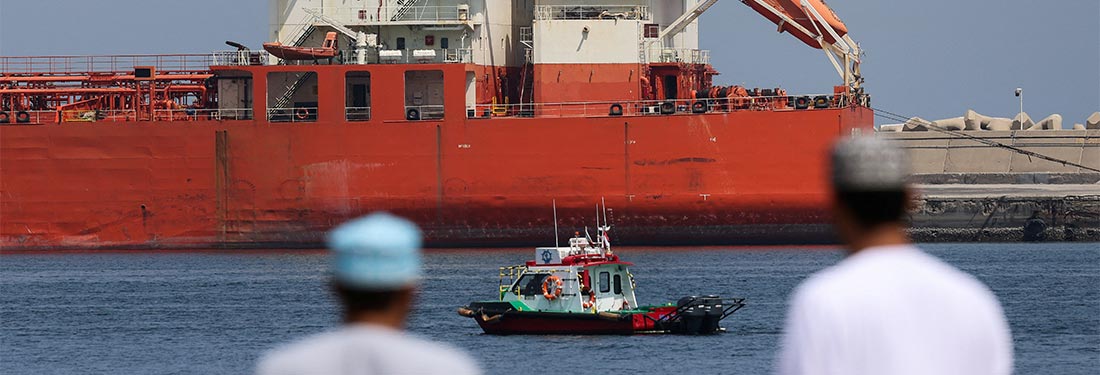
Men stand near the waterfront as a vessel sits at anchor, amid the US-Israeli conflict with Iran, at Sultan Qaboos Port in Muscat, Oman, 16 March 2026. REUTERS/Stelios Misinas
The US-Israel war on Iran is fraying the Gulf Cooperation Council and threatening the decades-long alliance with Washington as members pursue new coalitions and independent policies.
Just months ago, the Gulf monarchies appeared to have cracked the code of long-term security. US military bases guaranteed protection, a web of financial influence stretched from Wall Street to European football and the countries of the region united under the Gulf Cooperation Council (GCC) banner. The region’s oil wealth funded glittering cities, sophisticated airports, glass towers and unrivalled infrastructure. This decades-old architecture was working flawlessly.
However, on 28 February, Israel and the US jointly launched a war on Iran – the GCC’s larger, more powerful neighbour – and the GCC’s edifice started to fracture. Bahrain, Kuwait, Oman, Qatar, Saudi Arabia and the United Arab Emirates (UAE) all found themselves almost bearing the brunt of Iran’s retaliatory counter-strikes. Tehran explicitly stated that any country hosting US military bases – the presumed source of the Gulf’s peace of mind – used for the initial strikes, would be considered a ‘legitimate target’ of its vast arsenal of drones and missiles.
Iranian drone army
The threats were not a bluff. Explosions lit up the Persian Gulf’s nights. Videos of falling fragments of Iranian missiles mesmerised populations across the region as symbols of Gulf opulence trembled under dozens of buzzy low-cost drones. In Dubai and Doha, cities that had invested billions to become global hubs for sports, tourism, international conferences and aviation, the veneer of invulnerability shattered. Flights were grounded, trade was disrupted, expatriates flocked out and areas near icons like the sail-shaped Burj Al Arab luxury hotel were hit.
The war has caused severe maritime restrictions in the Strait of Hormuz, threatening to choke off the primary export route for Gulf oil, the region’s main income stream.
Europe has been given reason to doubt US security guarantees under NATO due to US President Donald Trump’s erratic behaviour and rhetoric. Gulf states are now questioning their security agreements with Washington after the war made it clear that stability in the region came in distant second to America’s commitment to protecting Israel. Despite hundreds of billions spent on US weapons and business deals in the region, Iranian drones reached the airspace of all six GCC states, exposing the limits of the US security guarantees. Gulf Arab analysts appeared nervous and scrambling on TV channels to offer assurances. And, as the war ground on, the perception grew that relying on the US no longer aligned with the needs of the GCC states, unleashing calls to recalibrate alliances across policy, finance and even public messaging.
Compounding the shock was the response, or lack thereof, from countries the Gulf had long bankrolled. Egypt and Pakistan, which have larger militaries, offered only limited immediate support, leaving Gulf states to confront the unreliability of even their financial clients in moments of crisis.
UAE breaks ranks
In the immediate aftermath of the strikes, the GCC briefly united, issuing a joint condemnation. That solidarity quickly buckled when the UAE broke ranks. It accelerated ties with Israel, a long-time regional enemy, in a pragmatic push for survival. Israeli air defence systems, including Iron Dome batteries, operated from Al-Dhafra Air Base near Abu Dhabi, helping intercept threats from Iran and Yemen. The UAE is reportedly bypassing traditional US arms delays by going to Israel directly. For Abu Dhabi, the calculus was straightforward; Israel could deliver advanced capabilities faster and with fewer political conditions than Washington.
When Pakistan stayed neutral, the UAE demanded early repayment of its $3.5bn deposits, forcing Riyadh to step in with $2bn to stabilise Islamabad, underscoring the growing differences between the two GCC allies.
Frustrated by what it saw as insufficient GCC support, the UAE signalled displeasure and announced its withdrawal from the Organization of the Petroleum Exporting Countries (OPEC) on 28 April, citing production strategy but the move clearly related to regional threat perceptions. The UAE stated, ‘the time has come to focus efforts on what national interest dictates.’
It’s time to consider closing the American bases, as they are a burden rather than a strategic asset
Abdulkhaleq Abdulla
Former adviser to the UAE government
Unlike the UAE, Saudi Arabia, the bloc’s largest country, has opted for a more measured approach – a noticeably different response from its neighbour’s more brazen public embrace of Israel. Riyadh maintains its position that official normalisation of relations with Israel remains on hold until there is a credible pathway for a Palestinian state.
In late April, the country hosted the five other GCC members at a summit in Jeddah to coordinate positions. Despite these discussions, the GCC members were surprised by the announcement of the UAE’s OPEC exit the same day. The UAE-Saudi fissure predates the war, but the conflict has opened it up further.
Riyadh now claims that the war may have been part of a plan by Israel, to drag the kingdom into full confrontation with Iran. ‘Had the Israeli plan to ignite war between us and Iran succeeded, the region would have been plunged into ruin and destruction,’ the former head of Saudi intelligence, Prince Turki Al-Faisal wrote in a column for Arab News. ‘Israel would have succeeded in imposing its will on the region and remained the only actor in our surroundings.’ Al-Faisal warned that ‘the outcome could have been the destruction of Saudi oil facilities and desalination plants.’
In early May, in a rare public rift with the Trump administration, Saudi Arabia denied Washington the use of its air bases and airspace for the US mission to secure shipping in the Strait of Hormuz. The move forced Trump to suspend the operation.
But, as Saudi Arabia and the UAE diverged, Oman and Qatar carved out a balancing act, preserving channels with Iran while managing ties to the GCC and Washington. Qatar, which shares its largest gas field, the North Field, with Tehran, has used its ties to Iran to position itself as a potential mediator, while quietly cracking down on pro-Iran voices in the country within the ranks of its media empire. Oman, traditionally a discreet diplomatic bridge that shares the narrowest pinch point of the Strait of Hormuz with Tehran, has steered clear of full alignment with either the more hawkish or accommodationist camps, offering instead to open diplomatic channels.
Both Qatar and Oman, along with, more recently, Saudi Arabia, have kept an off-ramp open with Tehran including phone calls between top diplomats. These approaches reflect a pragmatic diversification of maintaining US security ties without over-reliance, while keeping options open with neighbours and regional players including Iran itself.
By contrast, Bahrain and Kuwait, two smaller countries with restless Shiite populations, have remained more closely aligned with the US to ensure internal stability. Bahrain, home to the US Fifth Fleet, has emphasised its strong military partnership with Washington. Kuwait, too, has praised US security guarantees, showing less of an appetite for rapid diversification of relations compared with its larger neighbours. Their positions underscore that not all Gulf voices are shifting at the same pace or in the same direction.
The war may have failed to significantly change Iran, but it is reshaping alliances in the Gulf. A major internal debate has emerged in the GCC with the main argument suggesting that if US troops and bases cannot prevent strikes on Gulf soil, then US military hardware may be more valuable than the partnership. As with Europe, this divergence remains in its early stages. Full divorce from the US is not yet on the table, but the unquestioning trust that once defined the relationship has been tested, replaced by a colder pragmatism.
Abdulkhaleq Abdulla is a former adviser to the UAE government. ‘Mini-lateralists’ are now navigating a ‘post-American world’, he wrote in Emirati publication The National. In a widely circulated social media post, he added, ‘The UAE no longer needs America to defend it [...] What the UAE needs is simply to acquire the best and latest American weapons. Therefore, it is time to consider closing the American bases, as they are a burden rather than a strategic asset.’
Emad Mekay is a freelance journalist and can be contacted at emad.mekay@int-bar.org