US presidency: Supreme Court striking down Trump tariffs is ‘real rule of law assertion by the judiciary’
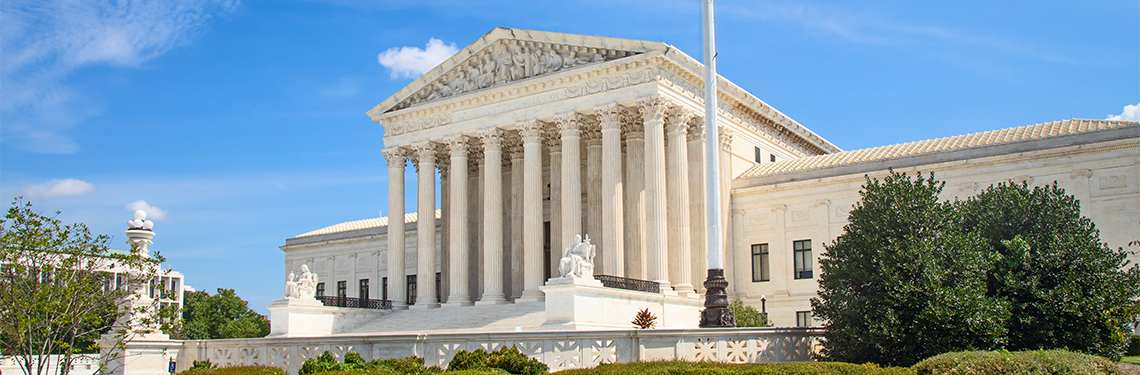
The US Supreme Court building in Washington, D.C.
The Supreme Court has struck down US President Donald Trump’s tariffs on US imports imposed in 2025. Amid the President’s sweeping claims of extraordinary powers, the Court’s judgment represents a victory for the rule of law and the constitutional framework in the US, say commentators.
In a 6-3 ruling, America’s high court declared that the president lacks authority to impose tariffs without congressional approval. The majority said that tariffs are taxes and that the US Constitution expressly reserves the power of taxation to the legislature. The justices further found that President Trump’s assertion of emergency powers to impose tariffs worldwide was not supported by statute.
It’s a ‘momentous’ judgment in terms of saying, “No, Mr President, your interpretation is wrong”’, says Raj Bhala, an officer of the IBA International Trade and Customs Law Committee. ‘This is a real rule of law assertion by the judiciary based on the text of the Constitution and statutes.’
To the extent President Trump staked his economic agenda on the imposition of tariffs, the Supreme Court’s rejection of that approach ‘was risky,’ says Bhala, who’s also a University Distinguished Professor at the University of Kansas School of Law. ‘Everything was at stake.’ Trump could have ignored the Court, potentially triggering a constitutional crisis.
The President had attempted to use a 1977 law, the International Emergency Economic Powers Act (IEEPA), to impose sweeping tariffs on imports. Trump administration officials argued that the IEEPA conferred unconstrained power to impose tariffs by declaring an emergency and that such decisions weren’t subject to judicial review. It was an unprecedented claim of authority no prior president had attempted.
President Trump can’t just, on a whim, impose ad hoc tariffs, sweeping in all products of any country he chooses
Keith Rockwell
Senior Research Fellow, Hinrich Foundation
In spring 2025 President Trump sought to impose ten per cent tariffs across the board on imports from nearly every country. He then made escalating threats of higher tariffs to negotiate so-called ‘deals’ with major trading partners, including the UK, the EU, Japan and South Korea. Economists estimated that the US collected more than $175bn in IEEPA tariff revenue, now subject to potential refund claims.
‘What common sense suggests, congressional practice confirms,’ Chief Justice John Roberts wrote in the Supreme Court’s majority opinion. ‘When Congress has delegated its tariff powers, it has done so in explicit terms, and subject to strict limits.’ The majority ‘hold that IEEPA does not authorize the President to impose tariffs,’ Roberts wrote.
Roberts was joined by Associate Justices Neil Gorsuch and Amy Coney Barrett, both appointed by President Trump. The three applied what has become known as the ‘major questions doctrine’, under which Congress must clearly and unambiguously authorise executive actions with vast economic or political consequences.
They were joined by Justices Elena Kagan, Sonia Sotomayor and Ketanji Brown Jackson who, without embracing the major questions doctrine, concluded that the plain language of the statute didn’t support President Trump’s claims. ‘Nothing in IEEPA’s text, nor anything in its context, enables the President to unilaterally impose tariffs,’ Kagan wrote in a concurring opinion.
‘The Supreme Court case brings a lot more certainty and clarity to US trade policy,’ says Keith Rockwell, a senior research fellow at philanthropic organisation the Hinrich Foundation and a former public affairs director at the World Trade Organization in Geneva. Where President Trump could previously threaten individual countries with tariff increases, he’s now constrained by statute. ‘He can’t just, on a whim, impose ad hoc tariffs, sweeping in all products of any country he chooses,’ says Rockwell.
President Trump reacted angrily to the ruling, criticising the Court’s conservative justices who opposed him. At the same time, he announced a new round of across-the-board tariffs under a different statute, initially at a ten per cent rate, which Trump later suggested would be increased to 15 per cent. The measures, imposed under section 122 of the Trade Act of 1974, have ultimately been imposed at the lower rate of ten per cent and may remain in force for up to 150 days unless Congress votes to extend them – a prospect widely regarded as unlikely. The President has previously argued that his tariffs will liberate the US from dependence on foreign goods and boost US jobs.
‘The good thing is, for all the people who had to pay the duties, now they should be able to get it back,’ says Yves Melin, Co-Chair of the IBA International Trade and Customs Law Committee. ‘For everybody else, it’s chaos.’
Melin, who’s a partner at Cassidy Levy Kent in Brussels, predicts the EU will seek to preserve its previous agreement with President Trump, which capped US tariffs at 15 per cent on most goods. The EU’s goal should be to maintain market access to the US, in Melin’s view. ‘I’m hoping that the EU is not going to overreact and [will instead] just continue with the approval of the reduction of the industrial tariffs in Europe for the US, so that we keep our 15 per cent as long as Trump is there,’ he says.
Amid ongoing uncertainty and complex diplomacy, EU lawmakers halted plans for European Parliament approval of the agreement reached with the US in summer 2025. Brussels had already paused action on the deal after President Trump threatened to impose new tariffs over Greenland.
Once the section 122 tariffs expire, the US Trade Representative’s office has signalled it plans to use other authorities under sections 232 and 301 to reimpose new tariffs on broad sectors of the economy and key commodities. ‘The tariffs are coming back, bigger if we have to, and fully within the law,’ said President Trump.
The President has already imposed tens of billions of dollars in tariffs under sections 232 and 301 on steel, aluminium, vehicles and certain products from China. Those remain in place after the Supreme Court’s ruling.
‘Businesses need clarity and security. But all these changes all the time, it doesn’t help the overall environment of investing in the US, trying to grow the market there, because the feeling is that what happens is sometimes arbitrary,’ says Leonard von Rummel, an officer of the IBA International Trade and Customs Law Committee. ‘The result in practice now is [that] it’s more uncertainty again,’ he adds, ‘until we know what the new tariffs are, if they are going to be upheld or not.’
What remains unclear is whether the statutory provisions of section 122, which require findings of a balance of payments problem in the US, have been met. The law has never been used to impose such sweeping duties. With billions in international trade at stake, President Trump’s latest move will probably be challenged in US courts. Litigation can also be expected over refunds of the IEEPA tariffs struck down by the Supreme Court.
Header image: swisshippo/Adobe Stock