Book review: Arbitration of Commercial Disputes (2nd edn)
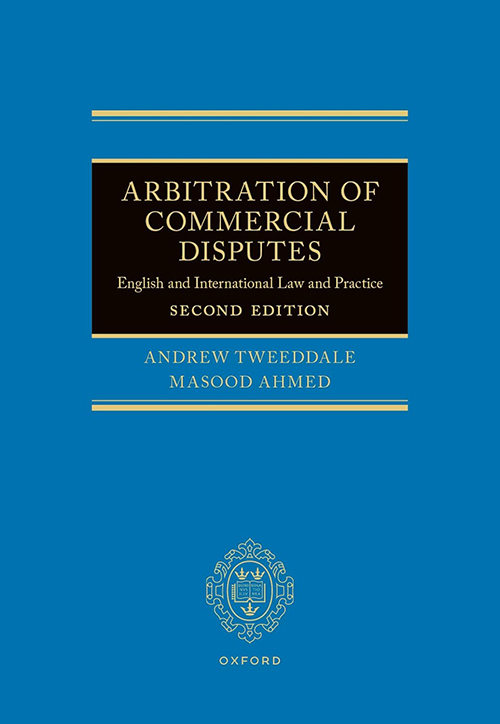
Arbitration of Commercial Disputes (2nd edn)
Authors: Andrew Tweeddale and Masood Ahmed
Published by: Oxford University Press
ISBN: 9780192882721
768 pages, £225
Publication date: 26 December 2026
Reviewed by Joanne Clarke
The second edition of Arbitration of Commercial Disputes arrives at a point when arbitration law is moving quickly, with recent legislative reform, a steady stream of important decisions, and the continued development of ‘soft law’ and guidance. It makes a genuinely useful contribution to that discussion. It sets out English arbitration law in a clear and methodical way, while also engaging with international perspectives throughout. One of its real strengths is that it manages to be detailed without becoming heavy going.
A notable feature of the book is its practicality. This is the sort of text that is likely to be reached for regularly rather than consulted only occasionally. It will be particularly helpful for practitioners, but it is also easy enough to navigate for those newer to the subject. The structure is logical and follows the steps of an arbitration from start to finish, which makes it especially easy to use in day-to-day work. The writing is direct and the treatment of authorities is concise without feeling superficial.
The book also does a good job of engaging with recent developments and is very up to date. The text reflects legislative and ‘soft law’ changes, including the Arbitration Act 2025 and the International Bar Association’s 2024 Guidelines on Conflicts of Interest, as well as more recent guidance on the use of artificial intelligence (AI) in arbitration and the growing role of technology more generally. These developments are dealt with in a straightforward way. Case law is brought in thoughtfully, with short explanations that make it easier to see why each decision matters.
That approach is particularly evident in the treatment of current legal issues. The discussion of anti-suit injunctions, for instance, considers Times Trading Corporation v National Bank of Fujairah (Dubai Branch) [2020] and notes its more recent application in Tyson International Company Ltd v GIC Re, India, Corporate Member Ltd [2025] (with the position now further shaped by the Court of Appeal’s 2026 judgment). Similarly, questions of arbitrability are addressed by reference to the Privy Council’s decisions in FamilyMart China Holding Co Ltd v Ting Chuan (Cayman Islands) Holding Corporation (Cayman Islands) [2023] and Sian Participation Corp v Halimeda International Ltd (Virgin Islands) [2024], which are used effectively to illustrate the underlying principles rather than simply cited. On litigation funding, the analysis covers the Supreme Court’s decision in PACCAR v Competition Appeal Tribunal [2023] and the Court of Appeal’s decision in Sony Interactive Entertainment Europe Ltd v Alex Neill Class Representative Ltd [2025], an area that remains in flux given the United Kingdom government’s stated intention to legislate.
The foreword by Mr Justice Henshaw notes that the book ‘explores areas of perennial difficulty’ and highlights, among other things, the book’s treatment of the exceptions to confidentiality, interim orders against third parties, the courts’ approach to stays under section 9 of the Arbitration Act 1996, and new provisions on peremptory orders and emergency arbitrators.
Taken as a whole, this is a book that does exactly what you would want it to do. It is dependable, up to date and easy to use, whether you are checking a specific point or reading more broadly. Just as importantly, it is written in a way that makes it feel like a working text rather than something purely academic. That is likely to be what keeps it within arm’s reach for those who work in this area.