Book review: Building Defects Law
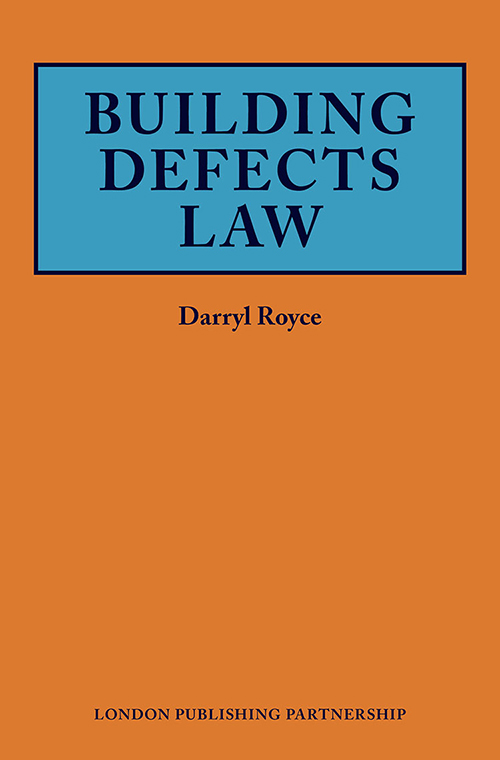
Building Defects Law
Author: Darryl Royce
Published by: London Publishing Partnership
ISBN: 978-1-916749-61-0
431 pages, £125
Publication date: 14 May 2026
Reviewed by Thayananthan Baskaran and Leezzie John
Building Defects Law provides a detailed consideration of building defects claims, which are often complex, technical and multifaceted. The book masterfully guides readers through every step of the process, with Chapter 1 setting out an introduction to the historical treatment of building failures under common law and the subsequent development of legislative regimes up until the current position.
Chapter 2 sets out a framework of essential concepts in building contracts relating to building defect claims. Chapters 3–7 subsequently address common causes of action for building defect disputes, including breach of contract of sale or agreement for lease, breach of warranty, breach of statutory duty under the Defective Premises Act 1972, professional negligence and claims under the Building Safety Act 2022. The legal remedies for such breaches are then explored in Chapter 8. The book also deals with insurance claims in relation to building defects in Chapter 9 and the role of expert evidence in Chapter 10. The book then concludes with Chapter 11, which provides general conclusions and the author’s insight on the success and shortcomings of the law governing building defects.
Chapter 7, ‘Claims Under the Building Safety Act’, offers a meticulous dissection of the Building Safety Act 2022 from the perspective of building defects litigation in the aftermath of the Grenfell Tower fire tragedy in summer 2017.
Chapter 7 begins with a brief historical backdrop, followed by an introduction of key statutory concepts under the Building Safety Act 2022. Further, as the author notes, in the wake of the Grenfell Tower disaster, many high-rise buildings across England were found to have significant defects, particularly as a result of the widespread use of combustible cladding. In this context, Chapter 7 highlights how the Building Safety Act 2022 provides for unsafe cladding as a special category of defect and the scope of cladding remediation. Chapter 7 also discusses the operation of the Building Safety Fund and the Cladding Safety Scheme as the Government of the United Kingdom’s initiative in facilitating the remediation of fire safety risks associated with cladding in high-rise residential buildings.
The central focus of Chapter 7 is the author’s analysis of the features, application, procedures, effects and significance of the statutory remedies provided under the Building Safety Act 2022. This includes, among others, Remediation Orders, which require a relevant landlord to carry out remedial works to remedy specified defects; Remediation Contribution Orders, which require a specified body corporate or partnership to contribute towards the costs of remedying relevant defects; and Building Liability Orders, which pierce the corporate veil and enable liability arising for certain building defects to be extended beyond the immediate defendant to its parent or associate companies.
Chapter 7 then concludes with a summary of the Building Safety Act Working Group’s proposed amendments to the Technology and Construction Court Guide to facilitate claims arising from the Building Safety Act 2022 in the Technology and Construction Court, including the management of such claims and a streamlined resolution process where multiple statutory remedies under the Building Safety Act 2022 are pursued simultaneously.
A key strength of Chapter 7 is the author’s ability to deconstruct the complexities of the provisions of the Building Safety Act 2022 with exceptional clarity, while also providing for the procedural and practical realities of its application.
Overall, the author’s insightful analysis provides a level of clarity and much needed guidance to legislation that is crucial to disputes involving construction and building defects. This authoritative, timely and indispensable addition to construction literature is a valuable resource for construction practitioners, academics and arbitrators alike.