Book review: Handbook on Construction Law and Arbitration
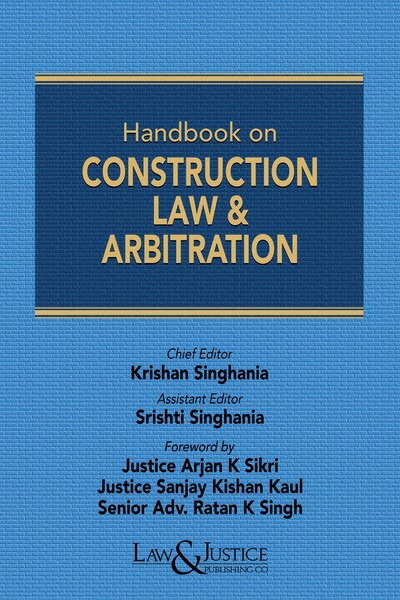
Handbook on Construction Law and Arbitration
Edited by Krishan Singhania and Srishti Singhania
Published by: Law and Justice Publishing Company
ISBN: 9789348076038
720 pages, £15.29
Publication date: 5 May 2026
Reviewed by Aleksander Godhe
It has become almost trite to observe that India is now one of the world’s most significant jurisdictions for construction law and international arbitration. The Handbook on Construction Law and Arbitration is therefore an essential work for practitioners seeking insight into one of the world’s leading construction markets without sacrificing a rigorous analysis of the international principles that underpin the discipline.
I’ve had the opportunity to examine a selection of the chapters in greater depth. Chapter 1 by Amit Kathpalia provides the reader with an excellent overview of the principal standard forms of construction contract used in practice. It considers not only the FIDIC forms, so frequently encountered in international projects but also the National Institute of Transforming India (NITI) Aayog model agreements. The chapter is enriched by practical case studies, including the use of early contractor involvement in the delivery of the United Kingdom’s High Speed 2 (HS2) project.
Chapter 3A is particularly noteworthy for its sophisticated treatment of the fundamental principles governing delay. Rajat Singla addresses both the foundational concepts and more contentious issues, including ownership of float and the prevention principle as considered in North Midland Building Ltd v Cyden Homes Ltd [2018] EWCA Civ 1744. Chapter 3B, by Ananya Kumar and Shriya Luke Murphy, complements this discussion by examining the uniquely Indian issues surrounding ‘No Damages for Delay’ clauses.
Chapter 8, authored by Mohit K Dubey and Dr Murali Jagannathan, will be indispensable to parties embarking on construction projects in India. It identifies the principal features of the applicable legal framework, including payment security and the interpretation of liquidated damages clauses, while consistently evaluating Indian law against international best practice. This comparative perspective is one of the book’s recurring strengths.
Chapter 13, by Tariq Khan and Aditya Singh Chauhan, examines the termination of construction contracts, observing that termination rights may arise under both common law and the parties’ contractual bargain. Although Indian law in this area shares its origins with the law in England and Wales, it has developed independently for some time. The chapter offers a careful and nuanced analysis of the substantive and procedural requirements governing termination. After all, a party that purports to terminate a contract without lawful justification may itself commit a repudiatory breach, thereby exposing itself to substantial liability.
From Chapter 15 onwards, the focus shifts to construction dispute resolution and the procedural framework governing arbitration. Chapter 16A, by Saniya Sharma, opens with an overview of the substantial backlog confronting the Indian courts. Against this background, the continued expansion of alternative dispute resolution appears almost inevitable if construction parties are to preserve cashflow, minimise project disruption and avoid the costs and delays associated with litigation. The Arbitration and Conciliation Act 1996 represented an important milestone in this regard, while recent mediation legislation may prove equally attractive to participants in the construction industry.
At the same time, the book does not shy away from recognising the challenges facing arbitration in India. Government-imposed restrictions on arbitration in certain public procurement contracts may suggest a degree of institutional scepticism towards the arbitral process. Likewise, the continuing controversy surrounding stamp duty in relation to arbitration agreements and awards remains an area ripe for reform. Chapter 18, by Srishti Singhania and Anjana Devi Karunahariram, provides a timely and insightful discussion of these issues. As the authors observe in relation to arbitration agreements, ‘[t]hese delays are against the objective behind the introduction of arbitration as an efficient alternative dispute resolution method’. In relation to arbitral awards, they conclude that ‘legislative reforms are necessary’.
Chapter 21A, authored by Krishan Singhania and Avni Singhania, examines the increasingly important role of preliminary meetings, which often determine the efficiency and trajectory of an arbitration, particularly in relation to jurisdictional and admissibility objections. The significance of these early procedural conferences is only likely to increase, as reflected in the 2026 amendments to the International Chamber of Commerce (ICC) Arbitration Rules. The authors also identify practical opportunities to use preliminary meetings to facilitate settlement or direct parties towards alternative forms of dispute resolution, thereby avoiding unnecessary arbitral proceedings.
The book then turns towards a detailed and practical examination of evidence in international arbitration in Chapters 22 and 23, before turning to arbitral awards in Chapters 25 to 27. These concluding chapters analyse the different forms of award together with tribunals’ powers to award interest and costs, areas that have not always received consistent treatment in the Indian courts. They also identify a number of practical pitfalls, including issues relating to currency and taxation, ensuring that the discussion remains firmly grounded in practice.
Overall, the Handbook on Construction Law and Arbitration provides a comprehensive and highly practical treatment of construction law and dispute resolution. Its greatest strength lies in combining detailed analysis of Indian law with an awareness of international practice, making it valuable not only for practitioners working in India but also for those engaged in cross-border construction projects. In addition to its treatment of current law, the book offers thoughtful reflections on the future direction of construction dispute resolution, including the growing role of online dispute resolution. It deserves a wide readership among construction lawyers, arbitrators and academics alike.