Climate crisis: UN General Assembly adopting landmark ICJ opinion expected to drive greater action on the environment
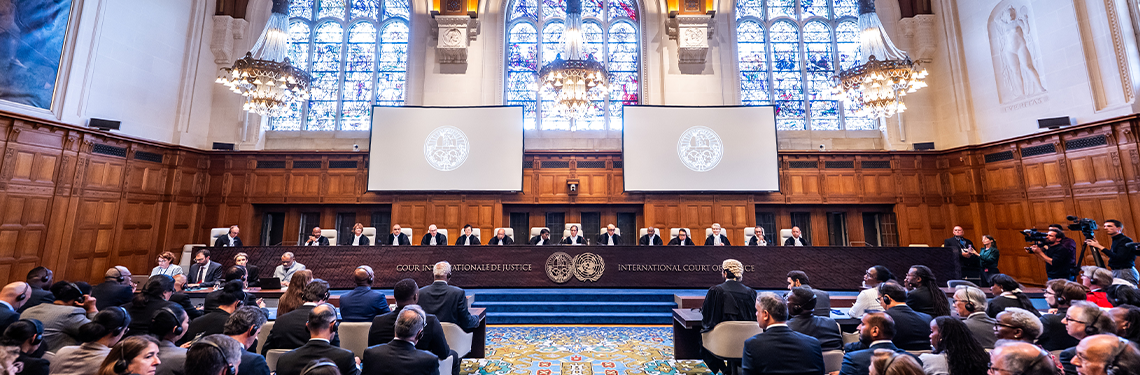
The International Court of Justice delivers its historic advisory opinion on the obligations of states in respect of climate change at the Peace Palace in The Hague, on 23 July 2025.
Photograph: UN Photo/ICJ-CIJ/Frank van Beek. Courtesy of the ICJ. All rights reserved.
In late May, the UN General Assembly adopted a resolution operationalising the 2025 landmark advisory opinion from the International Court of Justice (ICJ) on the obligations of states towards the climate crisis. The resolution is expected to drive greater action on the environment while offering a touchstone for future climate litigation.
The vote saw 141 of the 177 member states present back a resolution put forward by Vanuatu, which had 63 co-sponsors. Eight countries voted against it, while the remaining 28 abstained.
While some of the votes against the resolution – including from Russia, Saudi Arabia and the US – were expected, China’s vote in favour ‘was welcome,’ says Els Reynaers, Co-Chair of the IBA Environment, Health and Safety Law Committee and a partner at MV Kini in Mumbai.
That the UN has adopted such a resolution after 30 years of efforts by small island developing states to seek accountability for the climate crisis ‘is a game changer, with resonance not just for the climate but other multilateral fora, like the Biodiversity Convention or the negotiations for a [UN] plastic treaty,’ says Yamide Dagnet, Senior Vice President, International, at NGO the Natural Resources Defense Council in Washington, DC. ‘The real challenge now is, are we going to rise up to this opportunity that is offered to us to challenge the status quo in a different way?’
For Vishal Prasad, Director of Pacific Islands Students Fighting Climate Change – the NGO that began the campaign to get an ICJ advisory opinion back in 2019 – the resolution marks ‘the first step to bridging the gap between the legal and the real world.’
This is a game changer, with resonance not just for the climate but other multilateral fora, like the Biodiversity Convention or the negotiations for a [UN] plastic treaty
Yamide Dagnet
Senior Vice-President, International, Natural Resources Defense Council
Prasad highlights that the resolution requires the UN Secretary-General to produce a report for the General Assembly’s 82nd session – scheduled for September 2027 – assessing compliance with the ICJ’s opinion and identifying gaps in existing multilateral efforts.
The resolution is also ‘very significant for climate justice,’ he says, as it takes forward elements of accountability such as a duty to remedy harms, which may include making reparations.
‘This is a new development in the multilateral space – climate and liability and remedy have not gotten together so prominently prior to the advisory opinion and prior to this resolution,’ Prasad says. ‘This is a new door that’s opened up; we have a new pathway to chase accountability in a certain way.’ This includes through climate litigation – which Prasad now expects more of.
The resolution and the ICJ’s opinion are ‘building blocks’ for lawyers bringing cases against governments whose actions are contrary to their commitments, such as their Nationally Determined Contributions under the Paris Agreement, says Rick Saines, Managing Partner at Arden Climate in Chicago.
‘This is wind in the sails of proponents for bringing further cases that will rely upon the ICJ opinion, and will use the [well-supported] vote at the General Assembly for the premise that this is becoming settled international law, in a manner that does allow for there to be remedies,’ says Saines. ‘There will be cases, there will be arguments that have more credibility now.’
Saines adds that it’ll be harder for courts to dismiss cases early in the process now, such as for example one brought by a small island developing state versus another sovereign country. This means ‘that the cost of defending those cases, and the stakes of defending those cases, will rise,’ he says.
Pavi Jain, an officer of the IBA Business Human Rights Committee, says that cases in India in recent years act as a signpost for those that could follow in the near future, such as those concerning emissions. ‘Indian courts have also recognised these additional international law developments, and the question of whether litigants will be able to invoke the ICJ opinion alongside our right to life […] which has been used in several climate litigation cases – this is something I really want to watch out for,’ she says.
Highlighting a climate case that’s pending before the Indian Supreme Court, Jain – who’s a partner at Khaitan & Co in Mumbai – says she’s waiting to see how the ICJ opinion influences court rulings in this area.
Paul Schoff, a partner at MinterEllison who’s based in Sydney, says that, while neither the ICJ opinion itself nor the UN resolution are binding, their ‘influence will be felt as indirect implications flow’ over time.
The resolution ‘adds further political momentum to what is an already-active diffusion of the ICJ’s reasoning into domestic legal systems,’ he says. Schoff believes it ‘will operate to increase the use and influence of the ICJ opinion in domestic policy as well as litigation against, and potentially between, states and, given the ICJ opinion found that states have stringent duties of due diligence with respect to activities within their jurisdiction or control, against private entities.’
Indeed, Schoff says that the opinion and resolution ‘put investors on notice that environmental regulations will inevitably tighten.’ There will also be implications for investor–state dispute settlements (ISDS), as the opinion and resolution potentially undermine claims that emissions-producing activities were legitimately expected to remain unregulated.
‘States defending ISDS claims, such as [those] arising from fossil fuel phase-outs or the revocation of exploration licences, can now point to international law obligations requiring such action, strengthening proportionality arguments and potential defences to expropriation claims,’ says Schoff.