Hungary’s ‘second return to Europe’ is a boost for EU project and Ukraine
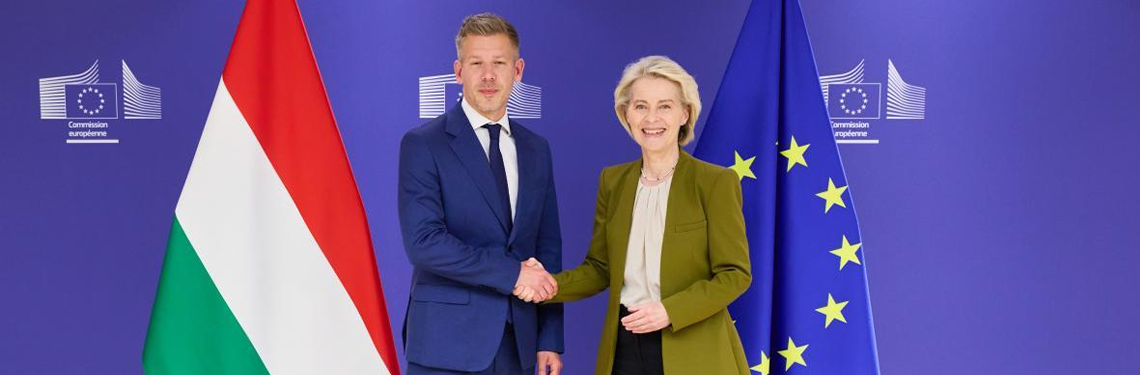
European Commission President Ursula von der Leyen and Hungarian Prime Minister-designate Péter Magyar discuss the steps required to unblock frozen EU funds on 29 April 2026.
© European Union, 2026, licensed under CC BY 4.0
Péter Magyar’s victory in the Hungarian elections in April, in which he ousted Prime Minister Viktor Orbán’s regime, is set to have swift and significant implications for the EU, Ukraine and Russia. Within the EU, it’s being seen as a significant boost to the European project. Within a week of Magyar’s party winning 141 out of 199 seats in the national parliamentary elections, officials from the European Commission visited Budapest for talks with the incoming Hungarian Prime Minister.
A week later, Magyar travelled to Brussels to continue those discussions. On the agenda was the unlocking of €17bn in EU funding to Hungary – money held back because Orbán’s regime had failed to meet several rule of law conditions. On the campaign trail, Magyar declared he would seek to unlock the funds. ‘If Magyar is not an ideological supporter of the EU, he is a pragmatic one,’ says Viktória Szilágyi, Co-Chair of the IBA European Regional Forum, who’s based in Budapest. ‘He reflects how many Hungarians are pro-EU: without it we are stuck, both economically and politically.’
Ostensibly, the EU has moved so quickly because €10bn of the withheld funding has been distributed through the bloc’s Recovery and Resilience Facility, which means Hungary could lose it completely if it doesn’t hit certain milestones by the end of August. The European Commission stated that the ‘high-level delegation’ it sent to Budapest was taking an ‘early opportunity’ to look at how to ‘make real progress to unlock EU funds earmarked for Hungary.’
Another, underlying reason for the Commission’s rapid response may be that Orbán was, for a long time, a thorn in its side, increasingly at odds with the EU on issues as wide-ranging as immigration, free speech, LGBTQI+ rights and anti-corruption measures. Brussels had been running out of ways to get him to conform to the bloc’s rules and thus avoid a full showdown with a Member State – one that would have cast a dark shadow over the European project.
If Magyar is not an ideological supporter of the EU, he is a pragmatic one
Viktória Szilágyi
Co-Chair, IBA European Regional Forum
Orbán’s actions were also divisive, with the European Commission perceived by some as failing to adequately respond to his regime’s behaviour. Others, meanwhile, suggested that the EU’s enlargement programme had gone too far, and that it was overreaching itself on social policy. Magyar’s victory is, then, a much-needed refresh of the EU’s raison d’être. Meanwhile, his electoral win has been hailed not only as a ‘victory for democracy’ but a ‘second return to Europe’ for Hungary.
Nowhere is Hungary’s realignment with the EU going to have greater impact than in Ukraine. Magyar is supportive of the EU’s stance in defending Ukraine, even if he’s more cautious about related matters, such as Kyiv’s bid for fast-track membership of the bloc – as a country sharing a border with Ukraine, Hungary is wary of becoming too involved in its conflict with Russia.
By contrast, Orbán had been blocking a €90bn EU aid package to Ukraine. He claimed – adopting the slogan ‘no oil, no money’ – that Ukraine was refusing to repair the Druzhba pipeline that runs through the territory and provides Russian oil to Hungary, which had been damaged by military strikes. Just ten days after the election, the pipeline was fixed and the block on aid dropped.
Szilágyi, a partner with Lakatos, Köves and Partners, says the public discourse regarding Ukraine will also change with the new government. ‘We will shift from autocratic communications that paint Ukraine as a mafia state, a threat to Hungarian interests and which could lead to militarisation and national service, to business-like, pragmatic communications,’ she says. ‘For instance, it might be that Hungary will now be in a better position to help with reconstruction and investments into Ukraine.’
A pivot to the EU and a pro-Ukraine position means Hungary has turned its back on Russia. But this was what the electorate wanted, says Peter Dosa, author of The Hungary Report, a blog providing independent analysis of Hungarian politics, democracy and EU affairs. ‘We know that we need Russian oil, certainly. But we only got our freedom from Communism in 1989. We want to get away from that past,’ says Dosa.
‘Orbán liked having a strong man as his political ally,’ he adds. ‘It gave him leverage and credibility within Europe; it gave him an aura that he is stronger than he actually is.’ Dosa believes that this relationship only benefitted Russia, however, by giving Putin access to the EU. Here, he references allegations that Péter Szijjártó, Orbán’s Foreign Affairs Minister, leaked sensitive information to his Russian counterpart. Szijjártó dismissed the allegations as attempts to influence the Hungarian election. ‘Putin stands to lose out from Hungary’s return to Europe,’ says Dosa.
Perhaps the most meaningful change Magyar represents is a way out of authoritarianism and populism. What’s interesting here is the nature of the challenger who ultimately defeated Orbán. ‘Magyar shares a history with Fidesz [Orbán’s party] so he’s not the traditional opposition,’ says Jan Rovny, a professor of political science at Sciences Po in Paris, who was part of the AUTHLIB project to examine the illiberalism phenomenon in Europe. ‘Magyar is unquestionably nationalist and socially conservative and so can appeal to supporters on the right. By taking a pro-EU, and economically open approach, he can also garner the support of the liberal left.’