China’s climate pledge
Stephen Mulrenan, IBA Asia Correspondent Monday 26 January 2026

Blue solar photovoltaic panels neatly arranged at the leading Photovoltaic Technology base in Yuncheng City, Shanxi Province, China on 17 August 2025. Alamy.com/Cynthia Lee
China has made a landmark pledge to reduce its economy-wide net greenhouse gas emissions by seven to ten per cent by 2035. Global Insight examines the implications and how China can be held to this commitment.
Although a major emitter of greenhouse gases, China has committed itself to a defined – and accelerating – climate transition. Its approach stands in contrast with that of the US – another significant emitter – whose President Donald Trump has pledged to boost oil and gas drilling and has rolled back green initiatives put in place by the previous administration in an effort to ‘unleash’ American energy.
China sent a large delegation to the COP30 climate conference in Belém, Brazil, which was held in November, whereas the US did not. And Beijing was probably quite pleased with the outcomes of the conference.
Yuhua Yang, a partner at Thornhill Legal in London, says the establishment of a Just Transition Mechanism at COP30 resonates strongly with China’s domestic approach to climate policy. ‘Beijing has repeatedly emphasised that decarbonisation must proceed in tandem with pollution reduction, ecosystem restoration and economic growth,’ she says. ‘COP30’s focus on balancing climate ambition with social equity aligns directly with this integrated vision.’
Meanwhile, the decision taken at COP30 to hold a formal dialogue on unilateral trade measures was welcomed in Beijing, says Yang. ‘China has consistently criticised what it sees as “green protectionism” and unilateral climate-related trade barriers,’ she says. ‘Bringing this issue into the UN climate process is seen as a diplomatic win that reinforces multilateralism and the rules-based Paris Agreement framework.’
Chinese leaders will probably interpret COP30 through a dual lens. Internationally, the conference was viewed as a success story for multilateral cooperation at a moment of significant geopolitical tension. Domestically, COP30’s outcomes reinforce China’s own ‘dual carbon’ strategy and validate the direction of its energy transition, industrial upgrading and national carbon market development.
Building the new system
COP30’s outcome document was widely viewed as a compromise: useful in establishing dialogue mechanisms, but unable to resolve deep disagreements over fossil fuel phase-out or the global emissions gap.
Against this backdrop, China continues to operate along two parallel tracks. Internationally, Beijing remains committed to multilateralism and to shaping the rules under the framework of the Paris Agreement. Domestically, its emphasis is on delivering tangible results at scale and according to its own timetable.
‘China takes a pragmatic, project-oriented approach,’ says Muyi Yang, a senior energy analyst for Asia at global energy think-tank Ember in Sydney. ‘It focuses on real outcomes, like building wind and solar projects, finding viable financial arrangements, and working with local and central authorities for policy support and incentives. The goal is to achieve tangible results, which helps local people see the benefits of the transition firsthand. This builds broad-based support, which is essential for strong policy commitment.’
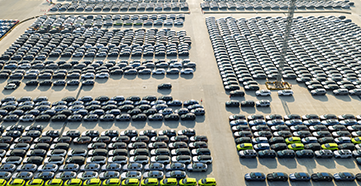
New energy vehicles park at the Taicang Port terminal yard of Suzhou Port and wait to be loaded onto the ship in Suzhou, Jiangsu Province, China, on 15 January 2026. (Photo by Costfoto/NurPhoto)
This project-oriented approach is evident in China’s latest climate plan. Initially announced by President Xi Jinping to the UN in New York in September – before being formally submitted in November – China’s nationally determined contribution (NDC) pledge for 2035 sets out a clear pathway for reducing emissions. And its targets are explicit.
President Xi has said that China will commit to reducing its emissions across its economy by seven to ten per cent by 2035. It’s the first time Beijing has committed to an absolute target rather than one linked to economic growth.
China also looked to ensure that its non-fossil energy share reached around 20 per cent of consumption by 2025, a target it reportedly exceeded. It hopes for this share to increase to 25 per cent by 2030 and then to surpass coal as the largest energy source by 2035.
In addition, China’s total installed wind and solar capacity must increase to six times its 2020 level by 2035. To help achieve this, financial regulators have instructed banks and insurers to prioritise lending to wind and solar projects – and this is supported by an updated green finance taxonomy.
China’s energy authorities are also simplifying approval processes in order to accelerate project development, for example by piloting a filing system for the ‘Thousand Towns, Ten Thousand Villages Wind Programme’ – a national initiative to boost clean energy in rural areas – and offering one-stop services for distributed solar.
Meanwhile, structural changes to how China’s power system is designed and operated are planned. These will be focused on large-scale storage, smart grids and an electricity system dominated by renewables.
‘In the short term, fossil fuels still function as the stabilising anchor of China’s energy system,’ says Yuhua Yang. ‘They ensure an uninterrupted power supply for heavy industry, manufacturing and transport, and they provide a buffer against economic or employment shocks that could arise from an overly rapid shift to renewables. China’s leadership describes this as […] building the new system before dismantling the old one.’
But the convenience of maintaining fossil fuels is tactical and temporary, she adds. ‘Strategically, China views long-term dependence on fossil fuels as a liability: exposure to geopolitically fragile import chains, vulnerability to carbon tariffs such as the EU’s Carbon Border Adjustment Mechanism and the risk of falling behind in the global race for green technologies,’ she explains.
Strategically, China views long-term dependence on fossil fuels as a liability
Yuhua Yang
Partner, Thornhill Legal
In short, while global negotiations – such as those at COP30 – struggle to move beyond procedural progress, China’s strategy is to let its construction sites speak louder than the negotiating room. In other words, it sees the real-world deployment of renewables, grid upgrades and storage technologies as the most credible way to fulfil international commitments.
‘China’s fossil-based development has driven economic growth, and so transitioning to clean energy is a major shift,’ says Muyi Yang. ‘However, the ship is already turning and, once a new direction is set, it gains momentum and cannot easily be reversed.’
Developed and developing
China’s economic development over the last 35 years has increased not only its prosperity but also its share of global emissions, which have risen from about 10–11 per cent in 1990 to almost 32 per cent in 2024. To put that in context, a ten per cent reduction in China’s emissions would equate to 1.4bn tonnes of carbon dioxide-equivalent a year. This is nearly four times the UK’s total annual emissions.
It means that any policy amendment around absolute targets is extremely significant in the fight against the climate crisis, not least because of its potential to significantly influence global climate trends.
However, changes in climate policy by the Chinese government weren’t always so potentially influential. The UN Framework Convention on Climate Change, adopted in 1992, is the central global treaty and international forum for negotiating collective action on the climate. It operates under the principle of ‘common but differentiated responsibilities’ and has led to key agreements such as the Kyoto Protocol and the Paris Agreement.
China was classified as a Non-Annex I party in 1992, which explains why it – along with other developing countries – has a lower obligation in terms of climate action than other, more developed, nations.
But Matthias Lang, Chair of the IBA Energy, Environment, Natural Resources and Infrastructure Law Section, argues that this concept had a design flaw. ‘The original design of the UN convention was that the developed countries reduced and the developing countries developed, but there was no specific target for any reduction by the developing countries at all, which was something the US complained about at the time,’ he says.
‘We have seen that the carbon dioxide reductions that mostly Western countries came up with were eaten up, or more than eaten up, by increases in the developing countries under the original framework,’ says Lang, who’s Head of the International Energy and Utilities Sector group at Bird & Bird in Düsseldorf. ‘This is obviously a problem if you want net carbon dioxide reduction as the climate has little regard for how much Western countries reduce versus how much others increase.’
If [China as] the biggest emitter starts working on a trajectory to reduce emissions, that can make a difference
Matthias Lang
Chair, IBA Energy, Environment, Natural Resources and Infrastructure Law Section
Lang says the world now needs net reductions. ‘The historical hope was that, at some stage in their development, developing countries would reach a point where they would start reducing carbon dioxide emissions rather than increasing them,’ he explains. ‘Until very recently, we really had not seen much of that and, given the quantities involved with China, that was a big problem. But if the biggest emitter starts working on a trajectory to reduce emissions, that can make a difference.’
Pledge pitfalls
Announcing China’s previous climate plan to the UN in New York in 2020, President Xi presented the country’s ‘dual carbon’ goals – specifically, for its carbon dioxide emissions to peak before 2030 and for it to achieve carbon neutrality by 2060.
However, while China’s 2025 climate plan covers all greenhouse gases – and not only carbon dioxide – President Xi notably omitted to provide any detail on when ‘peak levels’ of emissions might be hit. And even if this is achieved before 2030, this alone won’t be sufficient to put China on the rapid path needed for ‘carbon neutrality’, with the definition itself remaining open to debate.
Of more concern to the global community is that the emissions reduction proposed by China falls short of what’s needed to keep the long-term rise in global temperatures to under 1.5°C, as set out by the Paris Agreement.
Yuhua Yang says that China’s new absolute target, seen in isolation, isn’t aligned with the most stringent scientific benchmarks, which would require something closer to a 30 per cent reduction over the same period. ‘But Beijing sees the target as the top line constraint and believes the real drivers of decarbonisation are the concrete, measurable actions underneath it – for example, massive wind and solar deployment, rapid electric vehicle adoption, grid and storage upgrades, and expanding carbon-market tools,’ she says. ‘In other words, the target sets the direction, but projects deliver the outcome.’
Many climate models assume a near straight-line decline in emissions – steep cuts early, followed by continued reductions. Yuhua Yang says that the policy adopted by the Chinese government is closer to a ‘parabolic’ path: slower reductions before and just after peaking, followed by much faster cuts once the new energy system, industrial restructuring and supporting infrastructure are firmly in place.
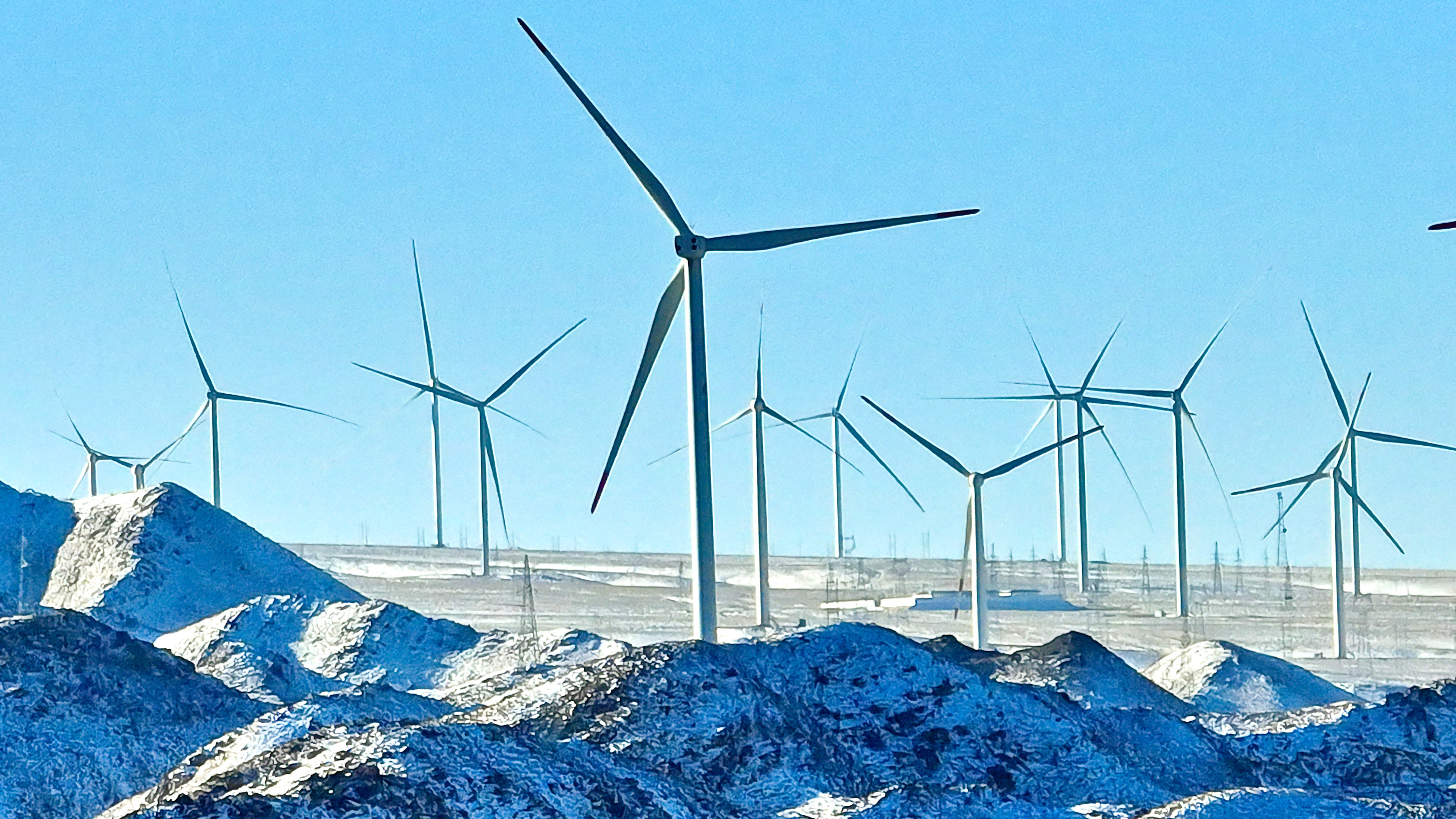
Wind turbines are standing in the snow in Zhangye, China, on 15 December 2023. (Photo by Costfoto/NurPhoto)
‘The bet China is making is that by achieving overwhelming scale and cost advantages in renewables, EVs and other clean technologies, it can accelerate emissions cuts after 2035 while also supplying the world with cheaper low-carbon equipment,’ she explains. ‘Whether this is sufficient depends on what you prioritise: the urgency of the scientific models, which argue for earlier and deeper cuts, or the feasibility and system stability of the transition in a country that is still heavily dependent on fossil fuels and is central to global supply chains.’
Yuhua Yang highlights that the real test probably won’t be ‘the absolute target itself, but whether China can deliver on its pragmatic, project-driven strategy in a way that allows its emissions curve to bend down sharply after 2035 and eventually converge with a 1.5 degrees Celsius compatible pathway’.
Some commentators have asked whether China can and will be held accountable over its decision to commit to an absolute emissions reduction target. Unlike countries with democratic processes, where governments are held to account by their electorates, no such checks and balances exist in China.
In contrast, some European nations have been challenged through the courts as to whether their legislation supporting climate action is sufficient to meet their national goals. For example, the 2021 Neubauer ruling by Germany’s Constitutional Court declared parts of the country’s Climate Protection Act unconstitutional because the climate targets set by the legislation were deemed to be insufficient and therefore violated the principle of intergenerational freedom.
Lang says different countries take different approaches. ‘In Western democracies, the approach has often been through climate laws or constitutional arguments,’ he says. ‘The debate has been about how to enforce political targets that are embedded in national climate laws. If a government adheres to its plan, enforcement is not the issue. China has followed a different approach whereby there is a political decision to do certain things and not others.’
China doesn’t have a climate law that allows citizens to sue the government, and the legal system is very different, says Christoph Nedopil Wang, Director of the Griffith Asia Institute in Brisbane. ‘Legally binding targets are powerful, but they’re usually based on national laws, not international laws. There is no international police force coming to anyone’s house.’
‘What we see elsewhere are governments walking back on climate commitments despite the very real risk of climate change. Large countries like the US have strong business interests in fossil fuels, geopolitical reasons to maintain control over energy flows, and a desire to counter China,’ he adds.
Wang explains that Europe is in a slightly different position, as it lacks the fossil fuel interests of the US, but also doesn’t benefit as much from the renewable energy transition as China. ‘You will always have diverse policy views, depending on whether countries are addressing climate change or supporting specific industries linked to their electorate,’ he says.
The UK was the first country to establish a long-term legally binding framework to reduce carbon emissions. Since the UK’s Climate Change Act was passed in 2008, many other countries have introduced similar legislation. The UK’s legislation initially aimed for an 80 per cent reduction in emissions, but this was amended in 2019 to legally require net zero emissions by 2050. However, some lawmakers have since expressed concerns about whether such a target can be met and the impact of doing so on the country’s economy.
In a similar vein, China’s own economic headwinds – such as weak domestic consumption, deflationary risks and a deepening real estate crisis – could make its 2035 emissions target harder to hit. ‘But they are also just as likely to reinforce the importance of the green transition as weaken it,’ says Yuhua Yang. ‘Beijing increasingly views clean energy, EVs, storage and grid upgrades not as costs, but as new engines of growth.’
For example, the EV sector’s contribution to China’s GDP is expected to rise from about 1.5 per cent in 2023 to between 4.5 and five per cent by 2030. And forecasts suggest that China’s green, low-carbon industries could exceed CNY 30tn by 2035. ‘In this context, accelerating decarbonisation is seen as a way to upgrade the entire economic structure and offset the decline of traditional sectors,’ says Yang.
So, while economic pressures pose real risks, they also sharpen the strategic case for the transition. China’s ability to meet the 2035 target will hinge on whether these new green growth drivers can expand fast enough to stabilise the economy and sustain momentum in emissions reduction.
Consequences overseas
One of the key challenges for any country is to reduce carbon emissions in a commercially viable way, and Matthias Lang says that, at some point, reducing one tonne of carbon dioxide can become so expensive that even wealthy countries can’t afford it. ‘The cost per tonne of carbon dioxide reduction is often not at the centre of the debate. Some methods cost vastly more than others, sometimes by a factor of 100,’ he says. ‘If you have a limited amount to spend, you could reduce far more carbon dioxide by choosing cheaper methods.’
He adds that one important and often overlooked point is that, for the global climate, it doesn’t matter where emissions are reduced so long as they are brought down. ‘Costs differ widely by location. Exporting solar panels to regions with high solar potential may reduce more emissions than deploying them elsewhere,’ he says.
While assessing the net effect of such investments is difficult, the efficiency of any approach depends on the country. One way in which China’s revision of its domestic approach to fossil fuel reliance may potentially have a significant impact is on countries overseas who rely on their East Asian benefactor for foreign investment.
For example, China has invested billions into critical energy infrastructure in Africa. And while this includes a mixture of fossil fuel infrastructure – such as refineries, extraction and pipelines – and renewable projects, the African continent has become one of China’s fastest growing clean energy markets.
Between 2010 and 2024, China invested over $66bn in Africa. In 2024, 59 per cent of its energy investment in the continent went to wind and solar. In the 12 months to June 2025, 20 African countries broke records for imports of solar panels, with the number of those products coming from China rising by 60 per cent in this period. ‘More than 660 million people in Africa still lack electricity while many governments are adopting clean energy targets,’ says Yuhua Yang, ‘so the continent’s own priorities make distributing solar and micro-grids far more practical than large, slow-to-build fossil plants.’
Since 2021, China has ceased building new coal plants overseas and has halted financing for most fossil fuel power projects. The few that are still being built are in support of industrial parks in countries such as Indonesia.
China’s investment in Indonesia’s nickel processing – which is critical for batteries, EVs and other clean technologies – still relies on coal. A report published by think-tank Ember in October, however, found that China could be a pivotal partner in enabling cleaner nickel in Indonesia. Muyi Yang says moving to green nickel will take time. ‘Existing fossil assets may be repurposed to support local clean energy solutions,’ he says. ‘This approach balances reducing coal reliance with avoiding financial crises for investors.’ Similar approaches could be adopted elsewhere, depending on local circumstances.
Policymakers globally often underestimate China, particularly around the green energy transition. There’s huge economic opportunity in greening the economy
Christoph Nedopil Wang
Director, Griffith Asia Institute
Given that oil and gas demand isn’t declining as fast as it is for coal, Christoph Nedopil Wang says China will probably continue to invest overseas in limited upstream oil and gas ventures tied to host country development needs. ‘The question is not just whether China will be a reliable fossil fuel partner, but how it can provide affordable, reliable energy provision,’ says Wang. ‘Policymakers globally often underestimate China, particularly around the green energy transition. There’s huge economic opportunity in greening the economy, which China has seized. Renewable energy production is cheaper than fossil fuel plants, though initial investments are needed. Energy price increases are largely due to gas and fossil fuel prices, not renewables. With the right investments, renewable energy can eventually reduce costs significantly.’
China’s energy transition should no longer be seen as a rhetorical gesture or incremental adjustment, but as a critical lever for redefining development itself, according to Ember’s October report. Decarbonisation has been reframed not as a constraint, but as a driver of international competitiveness, industrial upgrading and long-term economic resilience.
Yuhua Yang says China’s 2035 emissions pledge and ‘dual carbon’ strategy require its vast renewables industries to scale globally to sustain competitiveness. She says the pledge needs to be understood in the context of China’s wider economic goals, as espoused in its 15th Five-Year Plan, which was announced in October and covers the government’s policy priorities from 2026 to 2030.
‘The 15th Five-Year Plan frames renewable energy, advanced storage, hydrogen, next-generation photovoltaics and other emerging sectors as future engines of growth,’ she says. ‘The push is no longer simply about expanding capacity. It’s more about ensuring technological leadership, building resilient supply chains and developing a modern energy system capable of integrating massive volumes of clean power.’
Stephen Mulrenan is a freelance writer and can be contacted at smulrenan@lextelpartners.com