Migration crisis: Attacks on Ethiopian refugees at Saudi border raise serious human rights concerns
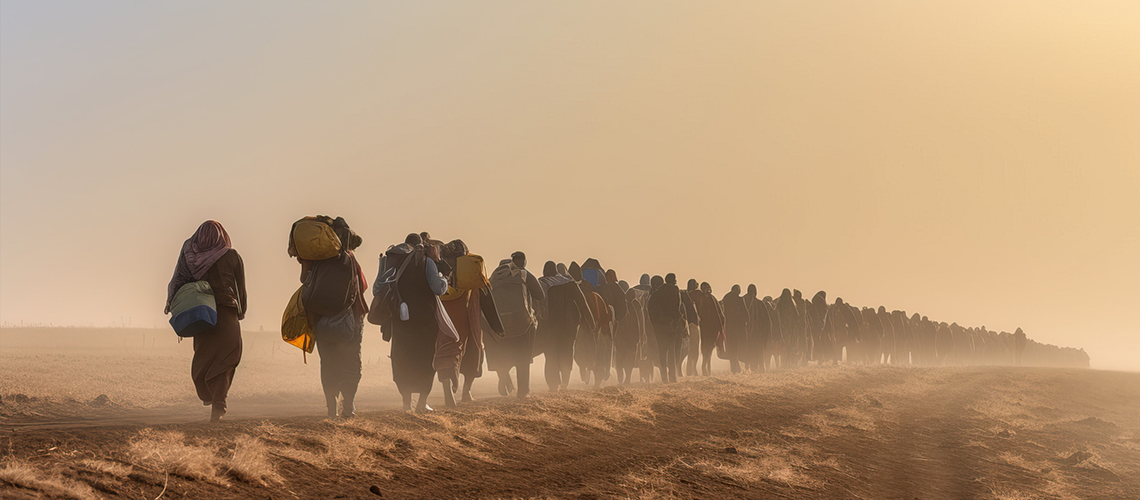
Saudi Arabia has killed hundreds of Ethiopian asylum seekers, many of whom were women and children, as they tried to cross from Yemen into the wealthy country, says a recent report from Human Rights Watch. Saudi authorities dismissed the findings as part of a nefarious campaign to target the kingdom as it seeks to modernise and reform its system.
The report shocked the world with ghastly details of the abuse. ‘In some instances, Saudi border guards first asked survivors in which limb of their body they preferred to be shot, before shooting them at close range’, the report said. ‘Saudi border guards also fired explosive weapons at migrants who had just been released from temporary Saudi detention and were attempting to flee back to Yemen […] A 17-year-old boy said border guards forced him and others to rape two girls after the guards had executed another migrant who refused to rape another survivor.’
According to Human Rights Watch, the killings started in March 2022 and could be continuing as Ethiopian refugees flee conflict and violence by their own government and detention camps run by the Houthi rebel militias in Northern Yemen.
Initially, Saudi authorities ignored the report but the Arabic service of the official Saudi Press Agency later ran a statement quoting an unidentified senior Saudi official attempting to discredit Human Rights Watch for relying on ‘noncredible’ sources. ‘Some organisations used false accusations against the kingdom to the point of publishing politicised and misleading reports and then promoting them within a suspect media campaign that serves dubious goals’, The Saudi Press Agency quoted the Saudi official as saying.
If committed as part of a Saudi government policy to murder migrants, these killings would be a crime against humanity
Human Rights Watch
The official, however, acknowledged there were shootings targeting Ethiopian refugees at the country’s long and mountainous southern borders but blamed unidentified ‘armed groups who, by using force, sought to compel large crowds to cross into the kingdom through the Saudi–Yemeni borders’. The Saudis may have been referring to earlier incidents documented by international organisations, including Human Rights Watch, that Iran-backed Houthi forces – which control most of Yemen and who have been fighting a war against Saudi Arabia since 2015 and until recently, had expelled thousands of Ethiopian migrants from northern Yemen – shot at them and killed dozens in an attempt to scare the rest into Saudi Arabia.
Human Rights Watch says its particular work on the Saudi incidents is well documented. The group’s staff interviewed 42 Ethiopian migrants along with friends and relatives of those who tried to cross the border and used 350 videos and photographs, along with satellite imagery that showed expanding grave sites and activities by the Saudi border patrols that set it apart from attacks by the Houthi militias in Yemen.
Saudi Arabia already hosts 750,000 Ethiopians according to international aid agencies. Half of those are believed to be in the country illegally. It is not clear when Saudi Arabia may have changed its policy to try and stop the flow of Ethiopian refugees but the UN says Yemen in recent years has increasingly become a transit point for migrants making their way toward Saudi Arabia often in groups of 200 people each.
The asylum seekers make the life-threatening journey on unseaworthy vessels and through Djibouti to Yemen, hoping to eventually reach the wealthy kingdom for jobs and for safety from the ferocious military campaign back home by Prime Minister and Nobel Peace Prize winner, Abiy Ahmed, who is trying to centralise control over all of Ethiopia, a country of 116 million people. As violence continues in the African nation, the exodus is likely to continue bringing Saudi treatment of refugees under further international scrutiny.
Ariel Orrego Villacorta of the IBA Immigration and Nationality Law Committee says that, under the non-refoulment rule of international law, countries cannot just send back refugees, particularly those ‘forced to flee their country of nationality or habitual residence due to the massive violation of human rights, foreign aggression, internal conflict, occupation or foreign domination; or due to events that seriously disturb public order’. Many of those conditions do apply to Ethiopian refugees.
Like many countries around the world witnessing growing hostility towards immigrants, Saudi Arabia appears to vilify asylum seekers to justify their repatriation. The Saudi media now routinely runs stories blaming ‘Ethiopian violators of border rulers’ for ‘drug dealings’. News of apprehension of Ethiopians for drugs and other crimes is almost a daily fixture in the Saudi press. Stories often run with pictures showing handcuffed men facing the wall with packets of drugs stacked up in front of them.
In August, the Saudi Interior Ministry said its forces were in the process of deporting thousands of people for illegal entry and drug-related crimes and that the majority were Ethiopians. The authorities appealed for tips from the public relating to similar violators. In March 2022, Saudi Arabia struck a deal with Ethiopia to repatriate more than 100,000 Ethiopians as part of the campaign.
Saudi Arabia has long attracted criticism from international rights groups over a series of issues including treatment of foreign labour, abuse against dissent and massive corruption. More recently the country was widely censured for the ruthless murder of Saudi dissident and journalist Jamal Khashoggi in 2018. And much to the shock of rights advocates, Mohammed Al-Ghamdi, a Saudi retired teacher and father of seven, was sentenced to death in August under the country’s draconian counterterrorism law for reposting social media criticism of Crown Prince Mohammed bin Salman. Al-Ghamdi had only ten account followers.
Bin Salman, the country’s 38-year-old de facto ruler, is, however, seeking to project a more modern image on the global stage. The country is hosting flashy and raucous concerts by top world music artists and recruiting football players with lucrative contracts to play in the local league, with a view to rivalling European leagues. In the business world, Riyadh is also working to project an image as a major start-up funder.
But despite the public relations blitz, Human Rights Watch says the killing of such a large number of immigrants is so egregious they constitute a grave international crime. ‘This report shows how the pattern of abuses has changed from an apparent practice of occasional shootings and mass detentions to widespread and systematic killings’, it says. ‘If committed as part of a Saudi government policy to murder migrants, these killings would be a crime against humanity.’
Image credit: Djomas/AdobeStock.com
IBAHRI condemns imprisonment of human rights defenders in Bangladesh
The International Bar Association’s Human Rights Institute (IBAHRI) has put out a statement condemning the imprisonment of rights defenders Adilur Rahman Khan and ASM Nasiruddin Elan. The IBAHRI calls on the Bangladesh authorities to release Khan and Elan immediately and overturn their convictions. Khan and Elan were remanded to Dhaka Central Jail on 14 September 2023 for two years and were ordered to pay a fine of BDT 10,000 each. Lawyers for Khan and Elan have said that they plan to appeal the ruling once the court issues the written judgment.
IBAHRI Co-Chair Mark Stephens CBE says: ‘The treatment of Adilur Rahman Khan and ASM Nasiruddin Elan is a despicable example of how the Bangladesh authorities are punishing, and attempting to silence, those speaking truth to power. The UN Basic Principles on the Role of Lawyers provide that lawyers must be allowed to carry out their work “without intimidation, hindrance, harassment or improper interference” and shall have the right to take part in public discussions of matters concerning the law, administration of justice and the promotion and protection of human rights.’
Khan is a human rights lawyer who has served as an advocate before the Supreme Court of Bangladesh as well as the former Deputy Attorney General of Bangladesh and is the Founder (now Secretary) of Odhikar, which is a prominent rights organisation. Elan is Odhikar’s Director.
It has been reported that both Khan and Elan have endured severe persecution by the government of Bangladesh, via public smear campaigns at both the organisational and personal level, because of their fight against human rights abuses and repression. This includes a conviction by the Cyber Tribunal of Dhaka, which found Khan and Elan guilty of publishing ‘fake, obscene or defaming information in electronic form’ under Section 57 of the Information and Communication Technology Act 2006.
‘We call for the immediate release of Khan, Elan and all other human rights defenders unjustly imprisoned’, Stephens adds.
Read the full statement here.
Training for corporate counsel on protecting companies and respecting human rights
The IBA Business Human Rights Committee and the IBA Legal Policy & Research Unit (LPRU) organised free, in-person training sessions for in-house lawyers and corporate counsel on business and human rights to promote respect for human rights while mitigating business risk and enhancing market viability. The sessions took place in New York, San Fransisco and Washington, DC, from 18–25 September 2023.
To assist corporate counsel in navigating an increasingly complicated environmental, social, corporate governance (ESG) and human rights environment, the main focus of the sessions was the United Nations Guiding Principles on Business and Human Rights – designed to raise awareness of international human rights law obligations as they apply to a business environment and to provide insight into the role of legal professionals in protecting and promoting these rights.
The US training sessions form part of the ongoing work of IBA Committees and the LPRU and their commitment to assist the legal profession in the business and ethics arena, with projects focused on topics including the climate crisis, gender equality and modern slavery.
Following the US training, the IBA plans to roll out the sessions to other locations around the world.
Read the full press release here.
Guatemala: IBAHRI condemns proceedings against Judge Carlos Giovanni Ruano Pineda
The International Bar Association’s Human Rights Institute (IBAHRI) condemns the pre-trial proceedings initiated against Guatemalan Judge Carlos Giovanni Ruano Pineda by the Foundation against Terrorism – described in reports as a far-right group with a track record of targeting judges and anti-corruption prosecutors.The group is seeking to remove Judge Ruano’s judicial immunity – a tool designed to empower judges to render unbiased and equitable judgments devoid of unwarranted external pressures or manipulations. If the Foundation against Terrorism is successful in its quest, Judge Ruano will be exposed to retaliation for exercising his judicial functions.
It is reported that more than 12 judges and prosecutors have fled Guatemala pending arrest warrants or charges. The legal action against Judge Ruano is symptomatic of judges and prosecutors finding themselves increasingly targeted for their work on sensitive corruption and human rights cases in Guatemala.
Find out more here.
IBAHRI raises concerns about discrimination against Ahmadiyya lawyers in Pakistan
The International Bar Association’s Human Rights Institute (IBAHRI) has issued a statement raising concerns about the treatment of lawyers belonging to the Ahmadiyya community in Pakistan, which is a numeric minority community in the country. It has been reported that these lawyers are being required to renounce their religion as a prerequisite to practise law, which is a violation of their right to freedom of religion or belief.
According to news reports, Ahmadi Muslim lawyers have also faced physical attacks in court on account of their faith. For example, on 27 April 2023, a 77-year-old Ahmadi Muslim Supreme Court advocate, Syed Ali Ahmad Tariq, was reportedly assaulted by other lawyers while practising in court.
In March 2023, the District Bar Association of Gujranwala announced that any applicant must positively assert that they are Muslim and denounce the teachings of the Ahmadiyya Muslim Community and its founder, Mirza Ghulam Ahmad. Khyber Pakhtunkhwa Bar Council also made a similar announcement in May 2023. This requirement contradicts international legal standards – specifically the right to freedom of religion or belief – as affirmed in Articles 18 of both the Universal Declaration of Human Rights (UDHR) and the International Covenant on Civil and Political Rights (ICCPR). Pakistan ratified the ICCPR in 2010, and as such, is bound by its provisions.
IBAHRI Co-Chair and Immediate Past Secretary General of the Swedish Bar Association, Anne Ramberg Dr Jur hc says: ‘Pakistan must ensure that its laws and policies are in accordance with international standards without exceptions’.
‘Religious minority communities such as the Ahmadiyya must be granted all rights as per the UDHR and the ICCPR, including the right to freedom of religion or belief as per Article 18 and Article 27 respectively. In particular, the latter that grants extra protections for minority communities’, she adds.
Read the full press release here.
UK government recognises Yazidi genocide
The International Bar Association’s Human Rights Institute (IBAHRI) welcomes the formal recognition by the UK government, on 1 August 2023, of the atrocities against the Yazidis as genocide. The Yazidis are a numeric minority religious group in Iraq and have been targeted by the non-state actor Daesh – also known as Islamic State, ISIL or ISIS. Acts committed against the Yazidis include mass killings, serious harm and measures to prevent births.
Dr Ewelina Ochab, IBAHRI Programme Lawyer and lead in the UK campaign for the atrocities to be recognised as genocide, said in a statement: ‘As we mark the ninth anniversary of the attack on Sinjar [on 3 August], this is an important step that many survivors have been waiting for – the recognition of the atrocities they suffered for what they are. However, recognition alone is not sufficient. Actions must follow, including actions to ensure justice and accountability for this genocide’.
The UK government initially refused to recognise the atrocities as genocide. The recognition comes after the conviction of three Daesh members of genocide in three different German criminal courts, as well as several campaigns led by civil society groups, including the IBAHRI.
‘The best interest and wishes of members of the community must be central to these actions’, Ochab adds.
Read the full statement here.
IBA and Florida State University offer international criminal law course
The IBA and Florida State University are offering a new and exciting opportunity to participate in a ground-breaking, distance learning, international law course. The 13-week course provides an introduction to international criminal law (ICL) and will cover war crimes, genocide and crimes against humanity.
The course is taught by Mark Ellis, the IBA’s Executive Director, and will cover subjects such as how ICL is created; the contemporary challenges it faces; the circumstances in which it applies; and the relationship between ICL and bodies such as the UN Security Council and the International Criminal Court, and between ICL and jurisdictions such as the US.
The course will take place remotely, with classes held on Tuesday mornings (0920–1110 EST) from 9 January 2024. Students who successfully complete the course will receive a certificate in Introduction to International Criminal Law.
For further information and for application details, please visit here.
Rule of law: controversial new legislation boosts power of Pakistan’s military

The amendment of two laws in Pakistan has granted the country’s military intelligence agencies additional powers that critics say will encroach on the rule of law and the potential for democracy in the country.
The Official Secrets Amendment Bill and the Pakistan Army Amendment Bill, both passed in early August, together make the disclosure of any information deemed sensitive to national security punishable with a prison sentence and fine, while broadening the definition of an enemy of the state to anyone who ‘directly or indirectly, intentionally or unintentionally’ engages with a foreign power or group guilty of anything seen as ‘prejudicial to the safety and interest of Pakistan’.
The new laws also grant the military’s Inter-Services Intelligence and Intelligence Bureau agencies powers to search – without a warrant – any person or place suspected of breaching the law.
According to Uzair Younus, Director of the Pakistan Initiative at international affairs think tank the Atlantic Council’s South Asia Center, the motivation behind the legislation is the belief that criticism of the armed forces on social media or on WhatsApp channels undermines the security and sanctity of the country and has an effect on their morale. But Marvin G Weinbaum, Director of Afghanistan and Pakistan Studies at the Middle East Institute in Washington, DC, believes the military simply wants a ‘free hand in making arrests and searches without having to be concerned with warrants’.
Given its purported effect on morale, simply criticising the military – which is the seventh largest globally, is influential in the country’s politics and whose intelligence services have been linked by organisations such as the UN Office of the High Commissioner for Human Rights to enforced disappearances – is now punishable, says Younus.
Related links
Democratic values and human rights are, as a direct consequence of these laws, being worryingly compromised
Tahera Mandviwala
Secretary-Treasurer, IBA Law Firm Management Committee
Pakistan’s government didn’t respond to Global Insight’s requests for comment.
The legislative changes ‘curtail civil liberties, freedom of expression and give excessive control to the military to intrude in civilian affairs’, says Tahera Mandviwala, Secretary-Treasurer of the IBA Law Firm Management Committee, Co-Chair of the IBA India Working Group and a partner at TDT Legal in Mumbai. ‘They have criminalised defamation of the armed forces and given intelligence agencies sweeping powers to target dissidents and political rivals. Democratic values and human rights are therefore, as a direct consequence of these laws, being worryingly compromised.’ The amendments, adds Younus, have had ‘a chilling effect’.
The country’s opposition leader and former foreign minister, Shah Mehmood Qureshi, has already been arrested under the amended Official Secrets Act for his alleged misuse of a diplomatic cable. His political party, Pakistan Tehreek-e-Insaf (PTI), has strongly condemned the arrest, saying it’s without justification.
The controversy isn’t only about the content of the laws but how they came to pass. The President of Pakistan, Arif Alvi, said in a statement on X, formerly Twitter, that he didn’t approve the amendments, raising the question as to their legality. But the Ministry for Law said that the President, as an alternative to assenting to the bills, could instead have referred them to parliament with ‘specific observations’. Alvi did neither, which meant that after ten days from the bills’ approval in parliament, the changes automatically became law. These events took place shortly before Pakistan’s parliament dissolved at the end of August.
In spring 2022, former Prime Minister Imran Khan, who was known for his anti-corruption stance, received a vote of no-confidence and was forced out of the position he’d held since 2018. In May, he was arrested on corruption charges. Khan described the charges as part of a military campaign designed to prevent him from participating in the upcoming general election. Over the years, he has been vocal in his criticism of the military and claimed it was behind an attempt on his life in 2022, allegations the military called ‘fabricated’. The Supreme Court later found this arrest to be illegal; however, Khan was arrested again in early August after a court found him guilty of corruption in a case involving the alleged selling on of gifts from heads of state. Khan denies all wrongdoing.
Following Khan’s arrest in May, a series of protests led by PTI supporters swept the country. In response, thousands of people linked to PTI were arrested. At the time, rights groups expressed concern about the arrests and subsequent reports of torture and forced disappearances. This only led to further criticism of the military, which Younus believes is the catalyst behind its push for increased powers. ‘Instability creates more space for the military to further assert itself in ways we may not like’, he says.
Until an election takes place, an interim government is at the helm, one that’s ‘entirely under the thumb of the military’, says Weinbaum, who adds that ‘the military is taking full advantage of this opportunity to put in place everything that’s on their wishlist’. The result, he says, is that any potential for ‘a flourishing democracy’ is threatened.
Mandviwala calls on the international community and particularly the legal sector to put ‘the right pressures on the systems to stop abuse of due process and protect the rule of law’. Indeed, in early September, the Pakistan Bar Council and the All Pakistan Lawyers Convention both organised strikes, calling for a date to be set for the country’s upcoming election, the release of political prisoners, an end to the military’s role in politics and for effective measures to be implemented to address Pakistan’s economic crisis.
Younus says the governments of other countries, such as the US, which is a large exporter from Pakistan, could push for a certain level of democracy to be maintained in the country. ‘But at this point in time, we need to put all these developments in Pakistan in the global context’, he says. He highlights coups in Africa, the war in Ukraine and democratic backsliding in parts of Asia. ‘I fear we might go back to the Cold War era where geopolitics […] will trump human rights and democratic reform in parts of the Global South’, adds Younus.
Image credit: Bumble Dee/AdobeStock.com