Climate crisis: UN General Assembly adopting landmark ICJ opinion expected to drive greater action on the environment
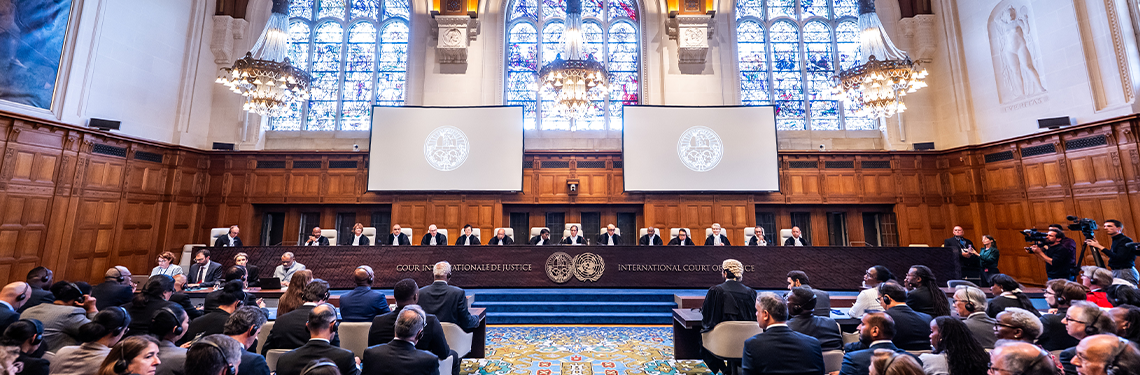
The International Court of Justice delivers its historic advisory opinion on the obligations of states in respect of climate change at the Peace Palace in The Hague, on 23 July 2025.
Photograph: UN Photo/ICJ-CIJ/Frank van Beek. Courtesy of the ICJ. All rights reserved.
In late May, the UN General Assembly adopted a resolution operationalising the 2025 landmark advisory opinion from the International Court of Justice (ICJ) on the obligations of states towards the climate crisis. The resolution is expected to drive greater action on the environment while offering a touchstone for future climate litigation.
The vote saw 141 of the 177 member states present back a resolution put forward by Vanuatu, which had 63 co-sponsors. Eight countries voted against it, while the remaining 28 abstained.
While some of the votes against the resolution – including from Russia, Saudi Arabia and the US – were expected, China’s vote in favour ‘was welcome,’ says Els Reynaers, Co-Chair of the IBA Environment, Health and Safety Law Committee and a partner at MV Kini in Mumbai.
That the UN has adopted such a resolution after 30 years of efforts by small island developing states to seek accountability for the climate crisis ‘is a game changer, with resonance not just for the climate but other multilateral fora, like the Biodiversity Convention or the negotiations for a [UN] plastic treaty,’ says Yamide Dagnet, Senior Vice President, International, at NGO the Natural Resources Defense Council in Washington, DC. ‘The real challenge now is, are we going to rise up to this opportunity that is offered to us to challenge the status quo in a different way?’
For Vishal Prasad, Director of Pacific Islands Students Fighting Climate Change – the NGO that began the campaign to get an ICJ advisory opinion back in 2019 – the resolution marks ‘the first step to bridging the gap between the legal and the real world.’
This is a game changer, with resonance not just for the climate but other multilateral fora, like the Biodiversity Convention or the negotiations for a [UN] plastic treaty
Yamide Dagnet
Senior Vice-President, International, Natural Resources Defense Council
Prasad highlights that the resolution requires the UN Secretary-General to produce a report for the General Assembly’s 82nd session – scheduled for September 2027 – assessing compliance with the ICJ’s opinion and identifying gaps in existing multilateral efforts.
The resolution is also ‘very significant for climate justice,’ he says, as it takes forward elements of accountability such as a duty to remedy harms, which may include making reparations.
‘This is a new development in the multilateral space – climate and liability and remedy have not gotten together so prominently prior to the advisory opinion and prior to this resolution,’ Prasad says. ‘This is a new door that’s opened up; we have a new pathway to chase accountability in a certain way.’ This includes through climate litigation – which Prasad now expects more of.
The resolution and the ICJ’s opinion are ‘building blocks’ for lawyers bringing cases against governments whose actions are contrary to their commitments, such as their Nationally Determined Contributions under the Paris Agreement, says Rick Saines, Managing Partner at Arden Climate in Chicago.
‘This is wind in the sails of proponents for bringing further cases that will rely upon the ICJ opinion, and will use the [well-supported] vote at the General Assembly for the premise that this is becoming settled international law, in a manner that does allow for there to be remedies,’ says Saines. ‘There will be cases, there will be arguments that have more credibility now.’
Saines adds that it’ll be harder for courts to dismiss cases early in the process now, such as for example one brought by a small island developing state versus another sovereign country. This means ‘that the cost of defending those cases, and the stakes of defending those cases, will rise,’ he says.
Pavi Jain, an officer of the IBA Business Human Rights Committee, says that cases in India in recent years act as a signpost for those that could follow in the near future, such as those concerning emissions. ‘Indian courts have also recognised these additional international law developments, and the question of whether litigants will be able to invoke the ICJ opinion alongside our right to life […] which has been used in several climate litigation cases – this is something I really want to watch out for,’ she says.
Highlighting a climate case that’s pending before the Indian Supreme Court, Jain – who’s a partner at Khaitan & Co in Mumbai – says she’s waiting to see how the ICJ opinion influences court rulings in this area.
Paul Schoff, a partner at MinterEllison who’s based in Sydney, says that, while neither the ICJ opinion itself nor the UN resolution are binding, their ‘influence will be felt as indirect implications flow’ over time.
The resolution ‘adds further political momentum to what is an already-active diffusion of the ICJ’s reasoning into domestic legal systems,’ he says. Schoff believes it ‘will operate to increase the use and influence of the ICJ opinion in domestic policy as well as litigation against, and potentially between, states and, given the ICJ opinion found that states have stringent duties of due diligence with respect to activities within their jurisdiction or control, against private entities.’
Indeed, Schoff says that the opinion and resolution ‘put investors on notice that environmental regulations will inevitably tighten.’ There will also be implications for investor–state dispute settlements (ISDS), as the opinion and resolution potentially undermine claims that emissions-producing activities were legitimately expected to remain unregulated.
‘States defending ISDS claims, such as [those] arising from fossil fuel phase-outs or the revocation of exploration licences, can now point to international law obligations requiring such action, strengthening proportionality arguments and potential defences to expropriation claims,’ says Schoff.
IBA calls on states to defend the International Criminal Court

The IBA has issued an urgent call to the 125 States Parties to the Rome Statute – the treaty establishing the International Criminal Court (ICC) – to publicly reaffirm their commitment to the ICC as efforts to discredit and dismantle the Court by the US government threaten justice for victims and survivors of genocide, crimes against humanity, war crimes and the crime of aggression.
‘The International Criminal Court exists because victims and survivors deserve justice when every other avenue has failed. It represents the international community’s promise that those responsible for the gravest crimes will not escape accountability simply because they wield power or because national systems cannot act,’ said IBA President Claudio Visco. ‘Standing with the ICC means standing with victims, survivors and justice itself.’
As the only permanent international court established to prosecute individuals responsible for the world’s gravest crimes when national jurisdictions are unwilling or unable to act, the ICC remains a vital safeguard against impunity and a cornerstone of the rule of law.
‘At a time when international justice faces unprecedented pressure, protecting the ICC is essential to ensuring that victims and survivors retain access to justice and that the rule of law prevails over impunity,’ said IBA Executive Director Mark Ellis.
The IBA’s comments follow a recent pattern of hostility from the US administration towards the ICC, including through the imposition of sanctions on Court officials such as the ICC Prosecutor, Deputy Prosecutors, eight judges and those cooperating with the Court including a United Nations Special Rapporteur and three civil society organisations. The IBA has consistently condemned all sanctions imposed on the ICC and those cooperating with it.
‘Efforts to erode [the ICC’s] legitimacy ultimately deny victims and survivors the opportunity for justice and weakens one of the international community's most important legal safeguards against impunity. States Parties must speak clearly and act decisively to defend the rule of law and the institution they collectively established,’ Ellis added.
Toolkit for defence lawyers released with Association for the Prevention of Torture
The International Bar Association’s Human Rights Institute (IBAHRI) and the Association for the Prevention of Torture have published the Toolkit for Defence Lawyers: Applying the Méndez Principles in Legal Practice.
The Méndez Principles propose a concrete alternative to coercive interrogations, which may include intimidation, threats or physical and psychological abuse, and can lead to false confessions, unreliable information and serious miscarriages of justice. They provide clear guidance to prevent abuse while ensuring that investigative and intelligence-gathering processes remain effective.
Based on regional and international human rights law, standards and norms, the Toolkit distils the most relevant tenets of the Méndez Principles and corresponding legal and ethical frameworks, for defence lawyers, legal aid providers and bar associations.
It seeks to support defence practitioners with using the Méndez Principles in legal practice and advocacy for a fairer criminal justice system in their own context, while recognising the wide variance in criminal law, procedure and practice, as well as the significant constraints and challenges facing defence lawyers around the world.
The Toolkit provides an overview of international standards on challenging tainted evidence and considers redress for interview-related wrongdoing. It shares legal strategies and arguments, comparative jurisprudence and guidance on cooperating with independent medical experts and oversight and other mechanisms.
The Toolkit’s co-author, Cath Kent, a Programme Lawyer with the IBAHRI, said ‘Challenging and excluding tainted evidence within criminal justice systems is central to upholding the absolute prohibition against torture and ill-treatment and a means of restitution for victims and survivors. We welcome further exchange and collaboration with criminal justice stakeholders on this vital issue in legal practice, which is a priority focus under the IBAHRI’s torture prevention programme’.
Concern raised over reported Israeli plans to expand control in Gaza
The IBAHRI has expressed grave concern about reported plans for expanded military control over significant parts of the Gaza Strip by the Israeli state. These actions raise concerns about forcible displacement, annexation and violations of international humanitarian law, as well further deepening the humanitarian catastrophe facing Palestinians.
‘What is at stake here extends far beyond Gaza. The prohibition on acquiring territory by force, the protection of civilian populations under occupation and the universal application of international law are foundational principles of the post-war international order,’ said IBAHRI Director Baroness Helena Kennedy LT KC.

The IBAHRI welcomes the recent coordinated measures taken by Australia, Canada, France, New Zealand, Norway and the United Kingdom to implement sanctions against networks financing and enabling settler attacks against Palestinians in the West Bank and calls for the international community to apply sustained political, diplomatic and economic pressure to end the ongoing violations.
IBAHRI reflects on 62nd session of UN Human Rights Council
The IBAHRI has published its reflections on the 62nd session and associated side events of the United Nations Human Rights Council (UNHRC), which was held from 15 June − 7 July 2026.
‘In its reflections, the IBAHRI welcomes the adoption of the resolution on the independence and impartiality of the judiciary, jurors and assessors, and the independence of lawyers, which renews the mandate of the UN Special Rapporteur on the independence of judges and lawyers. The IBAHRI actively participated in the negotiations of the resolution and particularly welcomed the inclusion of strengthened language condemning the increasingly frequent attacks on the independence of judges and lawyers.
The IBAHRI also co-sponsored and participated in a side event on judicial selection and appointment processes, which examined how transparent and merit-based judicial appointment systems can strengthen judicial independence, reinforce public confidence in the administration of justice and contribute to the protection of human rights.
Another side event convened by the IBAHRI focused on the role of women in legal professions. The discussion provided an opportunity to reflect on persistent challenges and emerging opportunities to advance gender equality within the legal profession.
Human rights issues in focus in recent IBA webinars
In July, human rights issues took centre stage in several IBA webinars, with panellists considering the multitude of challenges being faced in various jurisdictions around the world.
Hilda Heine, President of the Marshall Islands, provided a keynote speech in the webinar ‘Human rights and nuclear legacy in the Marshall Islands’, which was held in commemoration of the 80th anniversary of the first nuclear weapon test conducted in the country. The panel addressed the challenges and barriers to the full realisation of the human rights of the people of the Marshall Islands arising from the state’s nuclear legacy.
The IBAHRI continued its own programme of webinars, the first of which focused on the critical role of judicial independence in Syria’s political transition toward democracy, accountability and equality before the law. IBAHRI Co-Chair Mark Stephens CBE later moderated a webinar introducing the Regional Guidelines for Lawyers Representing Individuals Facing the Death Penalty and Execution in Asia, which aim to reduce the use of the death penalty by improving the quality of capital defence in Asia.
Other related webinars have explored such topics as the wavering authority of international law after failing to limit recent atrocities, and the prohibition on non-refoulement.
Access the IBA’s full programme of webinars here.
Winners of the 2026 IBA ICC Moot Court Competition announced

This year’s IBA ICC Moot Court Competition was won by Australia’s Bond University team. 2026 marked the 13th time the competition has been held. It was hosted in The Hague by the Grotius Centre for International Legal Studies at Leiden University in partnership with the IBA and brought together more than 550 students from 94 teams representing 48 countries.
The National Law School of India University was runner-up and Singapore Management University secured third place after a week of intense advocacy and legal argument before international criminal law experts. The Best Speaker Award was presented to Ayesha Khan of National Law School of India University.
‘At a time when the international legal order faces significant challenges, initiatives such as this competition play a vital role in fostering critical thinking, cross-cultural understanding and a commitment to the rule of law,’ said IBA President Claudio Visco.
Abortion rights: access to medication becomes focus of US legal battles

In May, the US Supreme Court ruled that doctors could continue to prescribe the abortion pill mifepristone. The ruling allows women seeking abortions to obtain the pill at pharmacies or via the mail, without an in-person visit to a doctor, in the 13 US states where the procedure is banned. But the case has now returned to a lower Louisiana court, where litigation aimed at limiting access to the drug continues.
The case is illustrative of how the landscape for abortion access has changed in the few years since the 2022 Supreme Court judgment in Dobbs v Jackson Women’s Health Organization. The Dobbs ruling overturned a nearly 50-year-old precedent protecting the right to abortion under the US Constitution. Since then, virtual clinics have emerged as a key means of accessing abortion in states with bans.
With the rise of telemedicine – the provision of healthcare services over distance – a new battlefront has emerged around the remaining federal protections for abortion access, namely the regulations that keep medication available and accessible nationwide, says Amy Myrick, Senior Attorney at the Center for Reproductive Rights, a global strategic litigation organisation. The next frontier for opponents ‘is to try to eliminate medication abortion, which has been serving as a lifeline for people across the country […] especially in states where abortion is inaccessible,’ she says.
According to figures from research group the Guttmacher Institute, the number of abortions provided by US clinicians in 2025 represents an increase of 21 per cent compared to 2020, the last year of national estimates before the Dobbs ruling.
Much of the legal conflict has moved from the federal courts to the state courts, who are deciding for the first time whether there are protections in their constitutions
Amy Myrick
Senior Attorney, Center for Reproductive Rights
Anti-abortion groups are aware that the Dobbs ruling ‘did not have the immediate impact they wanted in reducing abortion figures, but they’ve played the long game for 50-some years,’ says Kim Ricardo, a professor of law at the University of Illinois Chicago (UIC) School of Law. ‘They are skilled and strategic in trying to find all of the different ways to try to reduce access to abortion.’
In 2024, Ricardo and UIC sociology professor Claire Laurier Decoteau received a grant from the Society of Family Planning to investigate the barriers that pregnant people face in seeking abortion care. Over an 18-month period, the two interviewed over 120 women living in states with abortion bans who travelled out-of-state to undergo a procedure or used medication sent to their homes to terminate a pregnancy.
Abortion is legal in Illinois, but it’s surrounded by states with total bans or severe restrictions, such as Indiana, Kentucky and Iowa. It’s therefore emerged as a key state for abortion care since Dobbs. ‘Our study contains lots of stories from women who are just confused about what type of access rights they have and so have relied on organisations and cooperatives to help them filter through the large, vast amounts of information out there,’ says Ricardo.
According to a report from the Center for Reproductive Rights published in June, the make-up of state courts has been a key factor in determining abortion access. Ten states have amended their state constitutions to protect reproductive freedom since Dobbs. ‘Much of the legal conflict has moved from the federal courts to the state courts, with courts deciding for the first time whether there are protections in their state constitutions,’ says Myrick. ‘Every state court is able to decide whether their constitution protects abortion rights separate from the Supreme Court. State courts don’t have to follow the politics of the state, and a state constitution should be insulated from politics. So, state courts have a lot of potential to advance reproductive autonomy, including abortion.’
In spite of the increase in procedures, the ruling in Dobbs has nevertheless had a significant impact on women seeking abortions, on medical practitioners now operating under a criminal and potentially civil risk in states with bans and on people seeking to access reproductive healthcare more generally. ‘Four years after Dobbs, abortion hasn’t disappeared, but equal access to it has. What was once a constitutional right is now a postcode lottery shaped by geography, money, fear and legal uncertainty,’ says Mark Stephens CBE, Co-Chair of the IBA’s Human Rights Institute.
Highlighting that state-level abortion bans have exacerbated discriminations related to race, gender, socioeconomic status and class, he says that ‘access now depends much more on mobility, knowledge, financial and economic ability and legality to cross borders.’ In respect of the latter criteria, it’s notable that officials in some US states have threatened to prosecute individuals who assist others in travelling across state borders to undergo abortion procedures. In Louisiana, for instance, those providing abortion care face penalties of up to 15 years in prison and $200,000 in fines.
Meanwhile, there have been reports of patients with severe pregnancy complications being denied medically necessary care in states that have abortion bans in place, despite those bans allowing exceptions for healthcare reasons. ‘Rather than doing preventive medicine or prophylactic medicine, [doctors] wait to treat until the risk becomes extreme and their judgement couldn’t be second-guessed – which is not in the best interests of the mother, or anyone else,’ says Stephens, a consultant at law firm Howard Kennedy. ‘And it really challenges the Hippocratic oath of do no harm.’
Even though federal law prohibits Medicaid health insurance funding for abortion except in rare circumstances, states with abortion bans have barred the non-profit Planned Parenthood – which provides sexual healthcare services across the US – from receiving Medicaid reimbursements for services such as cancer screenings and contraception.
Meanwhile, in 2025, the Trump administration also made cuts to a federal programme that offers family planning and related preventative health services to low-income individuals, alleging violations of federal civil rights law and executive orders that target diversity, equity and inclusion programmes by some of the organisations receiving the funding. Although funding was restored following a court ruling in January, these cuts led to the closure of at least 20 Planned Parenthood health centres and local affiliates across the nation, according to the organisation.
As a result, care for those who need to see doctors in obstetrics and gynaecology has become more limited. Ricardo highlights that such doctors don’t only deal with reproductive healthcare, meaning there have been a number of ‘secondary and tertiary effects.’
Header image: Heidi Besen/Adobe Stock