US presidency: Supreme Court striking down Trump tariffs is ‘real rule of law assertion by the judiciary’
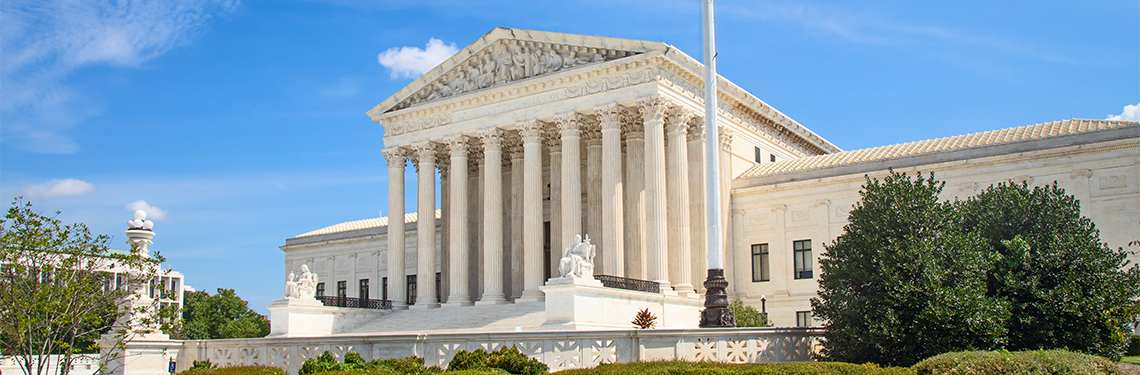
The US Supreme Court building in Washington, DC. swisshippo/Adobe Stock
The Supreme Court has struck down US President Donald Trump’s tariffs on US imports imposed in 2025. Amid the President’s sweeping claims of extraordinary powers, the Court’s judgment represents a victory for the rule of law and the constitutional framework in the US, say commentators.
In a 6-3 ruling, America’s high court declared that the president lacks authority to impose tariffs without congressional approval. The majority said that tariffs are taxes and that the US Constitution expressly reserves the power of taxation to the legislature. The justices further found that President Trump’s assertion of emergency powers to impose tariffs worldwide was not supported by statute.
It’s a ‘momentous’ judgment in terms of saying, “No, Mr President, your interpretation is wrong”’, says Raj Bhala, an officer of the IBA International Trade and Customs Law Committee. ‘This is a real rule of law assertion by the judiciary based on the text of the Constitution and statutes.’
To the extent President Trump staked his economic agenda on the imposition of tariffs, the Supreme Court’s rejection of that approach ‘was risky,’ says Bhala, who’s also a University Distinguished Professor at the University of Kansas School of Law. ‘Everything was at stake.’ Trump could have ignored the Court, potentially triggering a constitutional crisis.
The President had attempted to use a 1977 law, the International Emergency Economic Powers Act (IEEPA), to impose sweeping tariffs on imports. Trump administration officials argued that the IEEPA conferred unconstrained power to impose tariffs by declaring an emergency and that such decisions weren’t subject to judicial review. It was an unprecedented claim of authority no prior president had attempted.
President Trump can’t just, on a whim, impose ad hoc tariffs, sweeping in all products of any country he chooses
Keith Rockwell
Senior Research Fellow, Hinrich Foundation
In spring 2025 President Trump sought to impose ten per cent tariffs across the board on imports from nearly every country. He then made escalating threats of higher tariffs to negotiate so-called ‘deals’ with major trading partners, including the UK, the EU, Japan and South Korea. Economists estimated that the US collected more than $175bn in IEEPA tariff revenue, now subject to potential refund claims.
‘What common sense suggests, congressional practice confirms,’ Chief Justice John Roberts wrote in the Supreme Court’s majority opinion. ‘When Congress has delegated its tariff powers, it has done so in explicit terms, and subject to strict limits.’ The majority ‘hold that IEEPA does not authorize the President to impose tariffs,’ Roberts wrote.
Roberts was joined by Associate Justices Neil Gorsuch and Amy Coney Barrett, both appointed by President Trump. The three applied what has become known as the ‘major questions doctrine’, under which Congress must clearly and unambiguously authorise executive actions with vast economic or political consequences.
They were joined by Justices Elena Kagan, Sonia Sotomayor and Ketanji Brown Jackson who, without embracing the major questions doctrine, concluded that the plain language of the statute didn’t support President Trump’s claims. ‘Nothing in IEEPA’s text, nor anything in its context, enables the President to unilaterally impose tariffs,’ Kagan wrote in a concurring opinion.
‘The Supreme Court case brings a lot more certainty and clarity to US trade policy,’ says Keith Rockwell, a senior research fellow at philanthropic organisation the Hinrich Foundation and a former public affairs director at the World Trade Organization in Geneva. Where President Trump could previously threaten individual countries with tariff increases, he’s now constrained by statute. ‘He can’t just, on a whim, impose ad hoc tariffs, sweeping in all products of any country he chooses,’ says Rockwell.
President Trump reacted angrily to the ruling, criticising the Court’s conservative justices who opposed him. At the same time, he announced a new round of across-the-board tariffs under a different statute, initially at a ten per cent rate, which Trump later suggested would be increased to 15 per cent. The measures, imposed under section 122 of the Trade Act of 1974, have ultimately been imposed at the lower rate of ten per cent and may remain in force for up to 150 days unless Congress votes to extend them – a prospect widely regarded as unlikely. The President has previously argued that his tariffs will liberate the US from dependence on foreign goods and boost US jobs.
‘The good thing is, for all the people who had to pay the duties, now they should be able to get it back,’ says Yves Melin, Co-Chair of the IBA International Trade and Customs Law Committee. ‘For everybody else, it’s chaos.’
Melin, who’s a partner at Cassidy Levy Kent in Brussels, predicts the EU will seek to preserve its previous agreement with President Trump, which capped US tariffs at 15 per cent on most goods. The EU’s goal should be to maintain market access to the US, in Melin’s view. ‘I’m hoping that the EU is not going to overreact and [will instead] just continue with the approval of the reduction of the industrial tariffs in Europe for the US, so that we keep our 15 per cent as long as Trump is there,’ he says.
Amid ongoing uncertainty and complex diplomacy, EU lawmakers had halted plans for European Parliament approval of the agreement reached with the US in summer 2025. They have now voted to advance the deal, with additional safeguards included.
Once the section 122 tariffs expire, the US Trade Representative’s office has signalled it plans to use other authorities under sections 232 and 301 to reimpose new tariffs on broad sectors of the economy and key commodities. ‘The tariffs are coming back, bigger if we have to, and fully within the law,’ said President Trump.
The President has already imposed tens of billions of dollars in tariffs under sections 232 and 301 on steel, aluminium, vehicles and certain products from China. Those remain in place after the Supreme Court’s ruling.
‘Businesses need clarity and security. But all these changes all the time, it doesn’t help the overall environment of investing in the US, trying to grow the market there, because the feeling is that what happens is sometimes arbitrary,’ says Leonard von Rummel, an officer of the IBA International Trade and Customs Law Committee. ‘The result in practice now is [that] it’s more uncertainty again,’ he adds, ‘until we know what the new tariffs are, if they are going to be upheld or not.’
What remains unclear is whether the statutory provisions of section 122, which require findings of a balance of payments problem in the US, have been met. The law has never been used to impose such sweeping duties. With billions in international trade at stake, President Trump’s latest move will probably be challenged in US courts. Litigation can also be expected over refunds of the IEEPA tariffs struck down by the Supreme Court.
Annual Conference 2026 opens for registration
The 2026 IBA Annual Conference, which will take place at the Bella Center in Copenhagen, Denmark, has opened for registration. The world’s foremost event for international legal professionals, the Annual Conference will be held from 4–9 October and is expected to be attended by over 5,000 delegates, representing over 2,700 law firms, corporations, governments and regulators from more than 130 jurisdictions.
Over the week, hundreds of working sessions and social functions will take place, enabling the valuable exchange of information as well as abundant networking opportunities. It’s an opportunity for delegates to save time and money by meeting all their legal contacts under one roof. As in previous years, leading international figures will be in attendance to participate in events such as the Opening Ceremony, the ‘Conversation with’ interview sessions and the Rule of Law Symposium.
The Annual Conference will once again be the setting for an awards ceremony to celebrate the achievements of exceptional lawyers and to hear their stories. The IBA presents three awards at this ceremony – for contributions to human rights, pro bono work and to honour an outstanding young lawyer.
As a centre of sustainability, innovation and rich culture – one that’s an attractive place for investment – Copenhagen promises to be an ideal host city, offering a memorable location for the 2026 IBA Annual Conference.
The city’s historical sites include the Little Mermaid, Rosenborg Castle, Christiansborg Palace and Nyhavn waterfront, as well as the famous Tivoli Gardens theme park, Designmuseum Danmark and the Nationalmuseet. Visitors can take a boat tour of the city’s beautiful waterways, and experience Copenhagen’s world-class dining scene and cosy café culture.
To find further information about the 2026 IBA Annual Conference and to book, please visit https://www.ibanet.org/conference-details/CONF2635
An early bird discount is available for the Annual Conference. To receive the discount, bookings must be received – with proof of bank transfer payment for hard copy bookings – by Friday 10 July.
Raising the Bar: new report and podcast series on women in law

The IBA Legal Policy & Research Unit (LPRU), supported by the IBA Diversity and Inclusion Council and the IBA Women Lawyers’ Committee, has released its Phase 2 report of the ‘Raising the Bar: Women in Law’ project.
The ‘Raising the Bar’ initiative was launched in 2021 and is an ambitious multi-year project exploring women’s representation in the legal profession. Phase 2 comprised a global survey, open to women working across all legal sectors, as well as those who had left the profession within the last five years. It examined the individual experiences of women in the profession, offering insights into the barriers faced, their reasons for staying in or leaving the profession, and what has helped them to thrive in their careers.
The report was launched at law firm Debevoise & Plimpton in London on 12 March. The event explored the report’s key findings and recommendations, and discussed practical, evidence-based approaches to advancing gender equality in the legal profession.
The LPRU has also begun the second series of its ‘Inspirational legal women’ podcast, releasing the opening episode – an interview with Fiona McLeod AO KC, Senior Counsel – during International Women’s Week. The series will spotlight the experiences, leadership and perspectives of women shaping the legal profession.
Read more about the ‘Raising the Bar’ project here.
Nature-Intelligent Legal Services series launched
The IBA has launched a project for lawyers and law firms on nature-related risks, the implications for clients and how to embed solutions into client services. Consisting of three parts, the series features a business case guide explaining why legal service providers should act, a practical toolkit enabling law firms to evaluate client nature exposures and develop strategic positioning and a guide to embedding nature into legal advice and contracts.
Originally designed and co-authored by corporate and nature lawyer Jenni Ramos, and developed with the IBA Environment, Health and Safety Law Committee and the IBA Law Firm Management ESG Subcommittee with support from the IBA Legal Policy & Research Unit, the series has received input from biodiversity law experts and other IBA committees, with sectoral nature exposure methodology devised by sustainability consultancy Nature Positive.
In memoriam: John Horton Morrison, 1933–2026
The IBA was saddened to learn of the death of John Morrison, who passed away on 12 March at the age of 92. An Honorary Life Member of the IBA Council and Association, he had an enduring connection to the IBA, having served in many different positions over the years, particularly in the area of education. He was a long-term trustee and officer of the IBA Foundation and was instrumental in driving the IBA’s legal education programmes forward around the world over nearly 40 years.
After earning degrees from the University of New Mexico, Oxford University, University College London and Harvard, he entered the legal profession, joining Chicago firm Kirkland & Ellis (now an IBA Group Member), where he practised until his retirement, including in antitrust and commercial litigation, and as an arbitrator. He was active in the American Bar Association and contributed to numerous pro bono programmes in the Chicago area, among many other activities.
Hansel Pham, President of the IBA Foundation, said that John had served ‘with the highest distinction […] he was a beloved member of the Foundation and will be deeply missed.’
Another IBA friend, Mary Fran Edwards, former Chair of the IBA Committee on Continuing Legal Education & Professional Development (now known as the IBA Academic and Professional Development Committee), reflected on a ‘contribution to the legal profession [that] was unsurpassed through his dedication to legal aid and his volunteer work for the IBA, IBA Foundation and ABA. It was a privilege to work with him.’
John was recognised as ‘someone we all wanted to emulate’ by Tim Powers, a fellow Honorary Life Member of the IBA. In a message whose sentiment is undoubtedly shared by many both within the IBA and beyond, Tim outlined John’s impact and exemplary qualities: ‘John welcomed me as a young lawyer to the IBA and he stood by my side encouraging me, believing in me and sharing his incredible wisdom with me from that first day we met until the day we last spoke earlier this year. I will miss him and his welcoming smile dearly, not just because he was such a wonderful mentor and friend, but because he epitomised everything a lawyer and a member of the IBA should strive to be.’
Our condolences go to his family, friends and colleagues.
Global Employment Institute publishes new report on digital nomads
The IBA Global Employment Institute (GEI) has published a new short report focusing on digital nomads. Digital nomads leverage modern technologies to perform their work remotely, often combining their professional responsibilities with the pursuit of international travel and leisure. However, the term can be a broad label, creating challenges of a legal, taxation and immigration nature. This report focuses on the latter aspect – notably how governments are attempting to accommodate the nomadic workstyle through the creation of specialist digital nomad visa schemes.
The report is the result of a survey, in which respondents were asked to answer questions covering such issues as the availability and difficulty of obtaining a digital nomad visa, the duration of the visa’s validity and whether it could be renewed.
The report reveals that a majority of the surveyed countries have a specific visa scheme for digital nomads, which are mostly valid for a 12-month period. The schemes share a number of common features, with applicants needing a work source abroad and a salaried employment.
This short report serves as an introduction to the larger Digital Nomad Report, currently being drafted by the GEI, which aims to address all the relevant issues and provide useful information to enable multinational employers to navigate the digital nomad phenomenon in a beneficial and sustainable manner.
IBA Executive Director Mark Ellis awarded the Ukraine Order of Merit
IBA Executive Director Mark Ellis has been awarded one of Ukraine’s most distinguished state honours, the Order of Merit. The award is conferred by the President of Ukraine upon civilians for significant contributions made to supporting the country’s sovereignty, state-building, international cooperation and the defence of its democratic values.
Mark has always cited the cooperation of IBA committees across the Association, reflecting the breadth of expertise and inclusiveness, as one of the foremost reasons for the IBA’s work being recognised at the highest level in Ukraine.
From the first days of Russia’s invasion of Ukraine, the IBA spoke out clearly and unequivocally, condemning violations of international law. Since this time, the Association has remained steadfast in its support − advocating at the international level, mobilising legal expertise and standing in solidarity with Ukrainian lawyers, judges and legal institutions operating under extraordinary pressure.
Technology: Landmark US case ‘could launch a whole wave’ of addiction litigation

A jury in a Californian court has found Meta and Google liable for intentionally building addictive social media platforms that harmed the mental health of a woman who used them as a child. The case, decided in late March, opens the door to new ways to hold tech companies to account for allegations of harm to users.
The plaintiff in the trial was a 20-year-old woman identified by the initials KGM. She claimed to have been addicted to social media for over a decade and that her nonstop use of such platforms has caused various mental health issues.
The jury awarded $3m in compensatory damages, with Meta – the parent company of Instagram and Facebook – found to be 70 per cent responsible and YouTube’s owner Google 30 per cent. The jury further awarded $3m in punitive damages. Two other companies, Snap and TikTok, settled confidentially before the trial began.
The verdict provides leverage to litigants in a number of lawsuits being brought on similar grounds. There are over 20 other trials shortly set to begin in the Superior Court of Los Angeles County. ‘This is potentially the most impactful case in the US right now,’ says Philip Yannella, a partner in business litigation at Blank Rome in Philadelphia. ‘It could launch a whole wave of addiction litigation.’
Both companies will appeal. ‘Teen mental health is profoundly complex and cannot be linked to a single app,’ said Meta, adding the company remains ‘confident in our record of protecting teens online.’ Google’s spokesperson said the case ‘misunderstands’ YouTube, which the company argues is ‘a responsibly built streaming platform, not a social media site.’
The ability to pursue product liability design defect claims based on algorithms could greatly expand technology litigation
Philip Yannella
Partner, Blank Rome
Previous legal challenges to social media companies have largely been unsuccessful in the US because internet businesses are protected by Section 230 of the Communications Decency Act 1996, which broadly shields them from liability for third-party content posted online.
Lawyers behind the latest cases have adopted a different legal strategy, centred on negligence-based product liability. In the KGM case, they successfully argued that the design and functionality of the software products is what has caused addiction and harm, rather than content posted online by others.
Making software subject to product liability law is new legal territory in the US. ‘Design defect as a creature of product liability law has historically focused on physical fungible products, typically purchased by consumers over the counter,’ says Yannella. ‘The ability to pursue product liability design defect claims based on algorithms could greatly expand technology or website technology litigation.’
In the KGM case, lawyers for the plaintiff argued that design features such as ‘likes’, algorithmic recommendation engines, infinite scroll, autoplay and deliberately unpredictable rewards have been purposely engineered to maximise engagement by creating dopamine-driven feedback loops. KGM claimed this addiction fuelled her depression, anxiety, body dysmorphia and suicidal thoughts.
The arguments made by defence lawyers included that social media can’t be legally or clinically classified as an ‘addiction’. Those representing YouTube argued that the video sharing platform isn’t social media and is not addictive, meanwhile. Testifying in court, Meta CEO Mark Zuckerberg denied that the company seeks to make Instagram addictive to younger people and highlighted its measures to detect and remove underage users.
In another legal first, the jury in a case brought by the New Mexico Justice Department found in March that Meta had violated the state’s Unfair Practices Act by misleading the public about the safety of its platforms for young users, with children exposed to explicit material, for example. It’s the first time a US state has successfully sued Meta regarding child safety. Meta has been ordered to pay a penalty of $375m.
Meta will appeal and says it works hard ‘to keep people safe on our platforms’ and is ‘clear about the challenges of identifying and removing bad actors and harmful content.’
Cases such as these may ultimately result in a significant weakening of the legal immunity enjoyed by tech platforms and force the redesign of social media products.
Discussing the California case, Marc Berkman, CEO of the Organization for Social Media Safety, says such litigation plays ‘an important role because it brings internal practices and business incentives into the public conversation. That increased transparency helps drive change by informing families, shaping consumer expectations and encouraging policymakers to pursue stronger protections for young people.’
In the EU, Article 28 of the Digital Services Act (DSA) proactively addresses the protection of minors online by requiring platforms to disable features that promote excessive use by default, such as ‘streaks’ that reward users for increased engagement, push notifications and autoplay.
Tech companies must also remove or restrict persuasive design features intended to keep users engaged, such as infinite scroll, and include child-friendly tools that increase awareness of time spent on a platform.
‘Very large online platforms’, defined as those with over 45 million monthly active users in the EU, have the additional requirement to treat the safety of minors as a systemic risk. This means proactively analysing the risks posed by services and implementing ‘targeted measures’ to protect minors, such as age verification and parental controls.
In February, the European Commission preliminarily found TikTok in breach of the DSA on account of its addictive design. ‘TikTok will have to demonstrate that they have taken measures to change their design with respect to addictive functions like scrolling, notifications and recommendations,’ says Innocenzo Genna, Senior Vice-Chair of the IBA Communications Law Committee, highlighting that if TikTok doesn’t comply, it risks being fined or banned.
A TikTok spokesperson has said the findings present a ‘categorically false and entirely meritless depiction of our platform.’ The company intends to challenge them.
Several jurisdictions worldwide are introducing laws that prevent access to social media platforms for under-16s, potentially limiting the likelihood of future litigation related to young people. For example, in December Australia’s new online safety legislation took effect. It requires platforms to take reasonable steps to stop children under the age of 16 from creating, or retaining, accounts.
This doesn’t stop under-16s from using platforms that don’t require an account, such as YouTube, but according to Angela Flannery, Co-Chair of the IBA Communications Law Committee, this still makes it ‘more difficult to argue that the platforms were aware that such users were under 16 and targeted by the platforms.’
Header image: stokkete/Adobe Stock